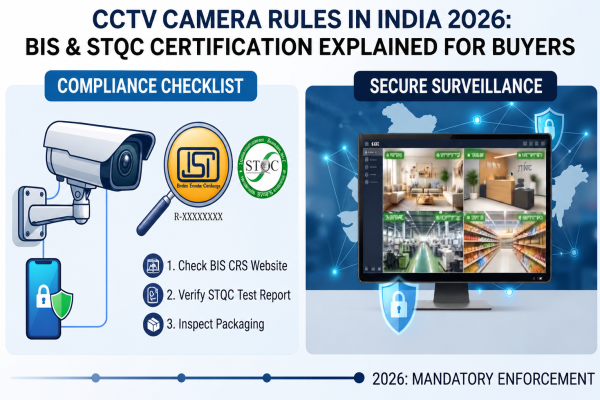
Buying a CCTV camera in India changed fundamentally in 2026. What used to be a simple choice was based on megapixels, night vision, and price. Now, strict national cybersecurity rules guide the decision.
Following notices by the Ministry of Electronics and Information Technology (MeitY), India has changed its rules. From 1 April 2026, stock-clearance relaxations were withdrawn. Non-compliant CCTV cameras can no longer be sold legally in India. Whether you are setting up surveillance for a home, an office, a retail store, or a government facility, understanding BIS and STQC certifications is essential before placing an order.
Why the Rules Changed in 2026
Modern IP and Wi-Fi CCTV cameras are essentially small computers connected to the internet. Historically, poorly secured cameras with hardcoded default passwords and unencrypted video feeds became prime targets for cyberattacks, botnets, and unauthorised surveillance.
To fix these gaps at the manufacturing level, MeitY introduced the Essential Requirements (ER) for CCTV security. This was done under the Compulsory Registration Scheme (CRS). After a two-year transition period and multiple extensions, full enforcement took effect on April 1, 2026. Even older inventory imported or manufactured prior to April 2025 cannot be legally sold unless it meets these security standards.
BIS vs. STQC: Understanding the Two Pillars
Buyers often confuse BIS and STQC, treating them as interchangeable. In reality, they represent two distinct steps in the compliance chain:
|
Regulatory Body / Standard |
What It Is |
Role in CCTV Compliance |
|
Essential Requirements (ER-01) |
MeitY’s technical cybersecurity rules for CCTV devices. |
Defines the mandatory hardware, firmware, and network security benchmarks a camera must pass. |
|
STQC (Standardisation Testing and Quality Certification) |
A directorate under MeitY. |
Runs accredited laboratories that physically and digitally test the camera and software against the Essential Requirements, issuing the official ER Test Report / Certificate. |
|
BIS (Bureau of Indian Standards) |
India’s national standards body. |
Grants the Compulsory Registration Order (CRO / CRS) license—identified by an R-number—once a camera passes electrical safety standards (IS/IEC 62368-1) AND holds a valid STQC/lab ER security report. |
In short: STQC (and BIS-recognized labs) tests the camera's cybersecurity; BIS grants the legal license (R-number) that allows the camera to be sold in India. For Video Management Software (VMS) and government/PSU procurement (such as on GeM), separate STQC software certification is also required.
What Does a Certified Camera Actually Protect You From?
When a CCTV camera passes STQC testing and receives BIS-ER registration, it has been verified across five core security areas:
-
Hardware Integrity: Includes tamper detection, secure boot (ensuring only authentic software loads when powered on), and a hardware root of trust so cryptographic keys cannot be easily extracted.
-
Firmware Security: Blocks unauthorized firmware modifications, prevents rollback attacks (downgrading to an older, vulnerable software version), and eliminates hardcoded factory passwords.
-
Encrypted Communication: Ensures video streams and login credentials sent between the camera, NVR, and mobile app use strong encryption (such as TLS/HTTPS) rather than plain text.
-
Interface Lockdown: Unnecessary debug and test ports are disabled so attackers cannot hijack the device physically or over a local network.
-
Supply Chain Transparency: The certificate explicitly records the camera’s System-on-Chip (SoC) make, model, country of origin, and exact firmware hash.
Who Needs to Follow These Rules?
-
Government, PSUs, and Sensitive Infrastructure: Strict compliance is mandatory. Buyers must verify both hardware BIS-ER registration and STQC certification for Video Management Software (VMS), alongside public procurement origin rules (PPP-MII).
-
Private Businesses, Housing Societies, and Retail Stores: Since dealers are legally barred from selling uncertified cameras after April 1, 2026, any new purchase, system expansion, or replacement unit you buy must be compliant.
-
Homeowners: Buying a BIS-ER-compliant Wi-Fi or 4G SIM camera protects your home network and private indoor feeds from unauthorised remote access.
-
Existing Installations: Cameras already installed on your walls before the cutoff do not need to be ripped out immediately, provided you are not buying or reselling uncertified stock. However, any newly purchased replacement cameras must meet the 2026 standards.
5-Step Verification Checklist Before You Buy
Because certification is tied to an exact model number, chipset, and firmware build—not just a brand name—you cannot assume every camera from a well-known manufacturer is compliant. Use this checklist before paying an invoice:
-
Request the Exact Model Number: Confirm the exact model code on the quote matches the physical unit being delivered.
-
Verify the BIS R-Number: Ask the vendor for the camera's BIS registration number (formatted as R-XXXXXXXX). Cross-check this number on the official BIS CRS portal (crsbis.in) to ensure the exact model is listed and active.
-
Ask for the ER-01 / STQC Test Reference: Request a copy of the Essential Requirements test report reference issued by STQC or a BIS-recognized lab.
-
Inspect the Packaging Declaration: Legally compliant units carry the BIS Standard Mark along with the mandatory declaration: "This CCTV camera complies with Essential Requirement(s) for Security".
-
Add a Compliance Clause to Purchase Orders: If you are procuring for an office, factory, or housing society, include a line in your Purchase Order stating that delivery is subject to valid BIS-ER registration and STQC test documentation, with full refund/replacement rights for uncertified stock.
Contact us today to find the perfect CCTV solution for your property.