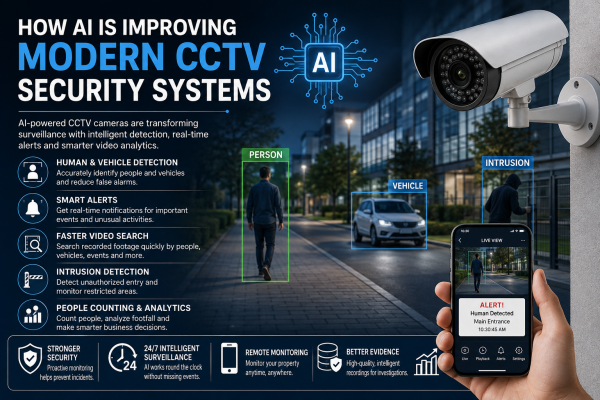
CCTV cameras have long been an important part of home, office, retail, and industrial security. Traditional CCTV systems primarily record video, which can then be reviewed when an incident occurs. However, modern AI CCTV systems are changing the way security cameras work.
By combining artificial intelligence, computer vision, and video analytics, modern surveillance systems can identify people and vehicles. They can detect unusual activity, send smart alerts, and help users find relevant footage faster.
What Is AI in CCTV Security?
AI in CCTV security means using artificial intelligence and video analytics to understand what happens in camera footage.
Instead of only detecting that “something moved,” an AI-powered CCTV system can often tell the difference. It can identify a person, vehicle, animal, or other object. It can also trigger an alert based on predefined rules. This helps turn CCTV from a passive recording system into a more proactive security tool.
How AI Is Improving Modern CCTV Systems
1. Human and Vehicle Detection
One of the most useful features of AI-powered CCTV cameras is that they can tell people and vehicles apart from other movement. They can tell the difference between a person, a vehicle, and other motion.
Traditional motion detection may trigger an alert because of:
-
Moving trees
-
Animals
-
Shadows
-
Rain
-
Headlights
-
Other environmental activity
AI-based detection can classify objects and focus alerts on events that are more relevant to security.
2. Real-Time Security Alerts
AI CCTV can monitor camera feeds continuously and send alerts when a predefined event occurs.
For example, a system may notify you when:
-
A person enters a restricted area
-
A vehicle enters a designated zone
-
Someone crosses a virtual boundary
-
Loitering is detected
-
An unusual event occurs after business hours
This can help security teams respond more quickly instead of discovering an incident only after reviewing recorded footage.
3. Faster CCTV Footage Search
Searching through hours or days of CCTV recordings can be time-consuming. AI video analytics can make this process considerably easier by indexing footage according to objects, people, vehicles, or events.
For example, an operator does not have to review a full day of recordings by hand.
Instead, they can search for footage of a specific vehicle or a person in a certain area.
This feature is useful for shops, offices, warehouses, factories, parking areas, and large properties with many CCTV cameras.
4. Intrusion and Perimeter Detection
AI surveillance systems can create virtual boundaries around sensitive areas.
If a person enters a restricted zone, the system can generate an alert. This can be useful for:
-
Warehouses
-
Factories
-
Construction sites
-
Office premises
-
Parking areas
-
Residential properties
-
Restricted entry points
AI-based perimeter monitoring can help security personnel concentrate on genuine events rather than continuously watching every camera feed.
5. Loitering and Unusual Activity Detection
Some modern AI security cameras can identify behaviour such as prolonged presence in a particular area.
For example, if someone stays near a restricted entrance for a long time, the system can generate an alert.
Other advanced analytics can identify patterns such as unusual movement, crowding, or objects being left behind.
6. People Counting and Crowd Monitoring
AI-powered video analytics can also be used beyond traditional security.
People counting technology can estimate how many people enter or leave a particular area. This can be useful for:
-
Retail stores
-
Shopping areas
-
Offices
-
Events
-
Reception areas
-
Public facilities
Crowd and queue analytics can also provide information about congestion and activity patterns. However, accuracy can vary depending on camera placement, crowd density, lighting, and people overlapping in the image.
7. Better Mobile and Remote Monitoring
Modern CCTV systems increasingly connect with mobile applications and remote monitoring platforms.
When AI analytics are integrated with mobile CCTV monitoring, users can receive notifications about important events rather than constantly watching live video.
For homeowners and business owners, this can make remote CCTV monitoring more practical and efficient.
AI CCTV vs Traditional CCTV
|
Feature |
Traditional CCTV |
AI CCTV |
|
Video recording |
Yes |
Yes |
|
Basic motion detection |
Yes |
Yes |
|
Human detection |
Limited |
Advanced |
|
Vehicle detection |
Limited |
Advanced |
|
Smart alerts |
Basic |
Advanced |
|
Intrusion detection |
Basic |
Intelligent |
|
Footage search |
Manual |
Faster AI-assisted search |
|
People counting |
Usually unavailable |
Available on supported systems |
|
Behaviour analytics |
Limited |
Available on advanced systems |
|
Remote notifications |
Available |
More event-focused |
The exact capabilities depend on the CCTV camera, NVR/DVR, software, AI chipset, and configuration being used.
8. AI Can Help Reduce False Alarms
One major advantage of AI video analytics is better filtering of irrelevant movement.
A traditional motion detector might respond to an animal or moving shadow. AI-based systems can classify objects and apply rules to separate people and vehicles from other movement sources.
This does not mean AI eliminates false alarms completely. Camera angle, lighting, weather, distance, image quality, and crowded scenes can all affect detection performance.
9. AI Can Upgrade Existing CCTV Systems
Businesses do not always need to replace every camera to introduce AI capabilities.
Depending on the existing infrastructure, AI analytics may be added through compatible NVRs, software, edge devices, or AI boxes. Some solutions are designed specifically to add analytics to existing surveillance infrastructure.
Before upgrading, however, it is important to check camera compatibility, resolution, network capacity, storage requirements, and the analytics supported by the existing system.
10. AI CCTV for Homes and Businesses
AI-powered surveillance can be useful in different environments.
For Homes
AI CCTV can help homeowners monitor:
-
Main entrances
-
Driveways
-
Parking areas
-
Gates
-
Gardens
-
Other vulnerable areas
Smart alerts can make it easier to know when relevant activity occurs.
For Shops
Retail businesses can use AI CCTV for:
-
Customer counting
-
Entrance monitoring
-
After-hours detection
-
Restricted-area alerts
-
Security monitoring
For Offices
AI surveillance can assist with:
-
Access-area monitoring
-
Perimeter security
-
Visitor movement
-
Restricted-zone detection
-
Incident investigation
For Factories and Warehouses
Industrial locations can benefit from:
-
Perimeter monitoring
-
Vehicle detection
-
Restricted-area alerts
-
People counting
-
Operational video analytics
Privacy and Responsible Use of AI CCTV
AI makes surveillance more powerful, but greater analytical capability also creates additional privacy and cybersecurity responsibilities.
Features such as facial recognition, number-plate recognition, and behavioural profiling can involve sensitive personal information. Organisations should therefore consider appropriate access controls, data protection, retention policies, and applicable privacy requirements when deploying AI surveillance. NIST notes that AI can create new privacy risks. It recommends managing privacy and cybersecurity risks for responsible AI use.
How to Choose an AI CCTV System
Before purchasing an AI CCTV camera, consider:
-
Camera resolution – Choose suitable resolution for the required viewing distance.
-
Night vision – Important for entrances, parking areas, and outdoor locations.
-
AI features – Check whether you need human detection, vehicle detection, intrusion alerts, or other analytics.
-
Storage – Make sure the NVR, DVR, SD card, or cloud storage supports your recording requirements.
-
Network connectivity – IP and Wi-Fi cameras require appropriate network infrastructure.
-
Mobile monitoring – Check whether the system supports reliable smartphone notifications and remote viewing.
-
Installation position – Camera placement can significantly affect AI detection performance.
-
Privacy and security – Protect accounts, networks, recordings, and access permissions.
The Future of CCTV Is More Intelligent
The biggest change AI brings to CCTV is the move from “recording everything” to “understanding what matters.”
Traditional CCTV remains valuable because recorded footage can provide evidence after an incident. AI adds another layer by spotting key events as they happen. It also makes large amounts of recorded video easier to analyze.
However, AI should not replace good camera placement, lighting, secure networking, proper setup, and human decisions. The best results come from combining the right technology with a well-designed security strategy.
Conclusion
AI is improving modern CCTV security systems by making surveillance smarter, faster, and more proactive. Human and vehicle detection, smart alerts, intrusion detection, people counting, behavior analytics, and faster video search help users.
These features help homeowners and businesses get more value from their CCTV systems.
For anyone planning a new AI CCTV installation, or upgrading an existing system, choose the right solution.
Base your choice on security needs, environment, budget, and desired AI features.
Contact us today to find the perfect CCTV solution for your property.