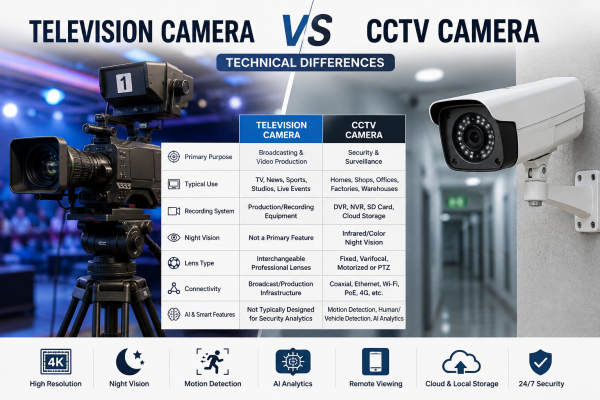
Many people use the terms television camera and CCTV camera interchangeably because both devices capture and transmit video. However, they are designed for very different purposes. A television camera is mainly built for broadcasting, live events, news, sports, and pro video production. A CCTV camera is made for security, surveillance, monitoring, and recording video.
Knowing the technical difference between a television camera and a CCTV camera can help you choose the right one. You can use it for your home, shop, office, factory, or professional video work.
In this guide, we compare television cameras and CCTV cameras. We focus on their purpose, image quality, and transmission. We also cover recording, night vision, and lenses. We review connectivity, storage, and security features.
What Is a Television Camera?
A television camera is a professional camera. It records video for TV shows. It is also used for news and sports. It is used in studios and at live events. It can be used for other types of media too.
These cameras are designed to produce high-quality video that can be sent to a broadcast or production system. Professional television cameras may support large image sensors, interchangeable lenses, optical zoom, advanced image processing, professional video outputs, and studio-control systems.
For example, television cameras used during cricket or football matches need to capture fast-moving subjects from long distances. They often use powerful zoom lenses and professional image stabilization to deliver clear footage to viewers.
Common Uses of Television Cameras
-
Television broadcasting
-
News reporting
-
Sports coverage
-
Live events
-
Studio production
-
Interviews
-
Concerts and entertainment programs
-
Professional video production
The primary purpose of a television camera is content creation and broadcasting, rather than security monitoring.
What Is a CCTV Camera?
A CCTV camera, or Closed-Circuit Television camera, is designed primarily for security and surveillance.
CCTV cameras monitor a particular area and transmit video to a recording or monitoring system. Modern CCTV systems can include cameras, DVRs, NVRs, network switches, storage devices, monitors, mobile applications, and cloud platforms.
Today, CCTV cameras are available with advanced technologies such as:
-
Full HD and 4K resolution
-
Infrared night vision
-
Color night vision
-
Motion detection
-
Human detection
-
Vehicle detection
-
AI-based video analytics
-
Remote mobile monitoring
-
Two-way audio
-
PTZ control
-
Smart alerts
-
Cloud and SD-card storage
The primary purpose of a CCTV camera is security, surveillance, monitoring, and evidence recording.
Technical Difference Between Television Camera and CCTV Camera
The most important differences are related to their design, video transmission, recording system, lens technology, night vision, connectivity, and intended application.
|
Feature |
Television Camera |
CCTV Camera |
|
Main purpose |
Broadcasting and video production |
Security and surveillance |
|
Typical use |
TV, sports, news, studios |
Homes, shops, offices, factories |
|
Recording |
Production/recording equipment |
DVR, NVR, SD card or cloud |
|
Night vision |
Not normally a primary feature |
Common feature |
|
Infrared |
Generally uncommon |
Common in many models |
|
Motion detection |
Not a primary security function |
Common |
|
AI detection |
Production-focused features |
Human/vehicle/security analytics |
|
Lens |
Professional/interchangeable lenses |
Fixed, varifocal, motorized or PTZ |
|
Remote monitoring |
Depends on broadcast setup |
Common |
|
Weather resistance |
Model dependent |
Common in outdoor models |
|
Continuous surveillance |
Not the primary purpose |
Designed for continuous monitoring |
|
Network connectivity |
Broadcast/production infrastructure |
Ethernet, PoE, Wi-Fi, cellular, etc. |
1. Difference in Purpose
The biggest difference between CCTV and television camera is their purpose.
A television camera is operated to capture footage that will be watched by an audience. It is normally part of a professional production environment.
A CCTV camera continuously observes an area to improve security and provide recorded evidence.
For example, a camera at a cricket stadium may film the match for TV viewers. CCTV cameras around the stadium monitor entrances, parking areas, corridors, and restricted zones.
Therefore, although both are video cameras, their applications are completely different.
2. Difference in Video Transmission
Television cameras generally work as part of a professional broadcasting system. Their video can be transferred to production equipment, video switchers, recording systems, broadcast servers, or transmission equipment.
CCTV cameras use technologies specifically designed for surveillance.
Traditional analog CCTV cameras commonly transmit video through coaxial cables to a DVR. Modern IP CCTV cameras transmit digital video through computer networks, generally using Ethernet cables.
Some wireless CCTV cameras use Wi-Fi, while SIM-based or 4G CCTV cameras can transmit video through cellular networks.
This makes modern CCTV systems suitable for remote monitoring and network-based surveillance.
3. Difference in Recording System
Recording is one of the most important functions of a CCTV system.
A CCTV camera can send footage to:
-
DVR
-
NVR
-
MicroSD card
-
NAS storage
-
Cloud storage
-
Hybrid storage systems
Users can search recorded video by time, date, motion, person, vehicle, or other events. This depends on the camera and recording system.
Television cameras, on the other hand, are generally connected to professional production and recording equipment. Their footage may be recorded for editing, broadcasting, or archiving.
Thus, the CCTV camera recording system is designed around security surveillance rather than television production.
4. Difference in Night Vision
Night vision is a major feature of many CCTV cameras.
Security cameras may use infrared LEDs to capture images in darkness. Some advanced models also offer color night vision using low-light sensors, white-light illumination, or advanced image processing.
Common CCTV night-vision technologies include:
-
Infrared night vision
-
Smart IR
-
Color night vision
-
Low-light imaging
-
Full-color night vision
Television cameras can work well in low light, but infrared security night vision is not their main purpose.
This is why CCTV cameras work better for monitoring homes, shops, warehouses, parking areas, and outdoor locations at night.
5. Difference in Lens Technology
Both television cameras and CCTV cameras can use different types of lenses, but their applications differ.
Professional television cameras can use interchangeable lenses with powerful optical zoom. These lenses are designed for professional production and long-distance shooting.
CCTV cameras may use:
-
Fixed lenses
-
Varifocal lenses
-
Motorized lenses
-
PTZ optical zoom lenses
A fixed-lens CCTV camera is often used when the monitoring area is known and rarely needs adjustment.
A varifocal CCTV camera allows the viewing angle to be adjusted during installation.
A PTZ CCTV camera can pan, tilt, and zoom, making it useful for monitoring large areas.
6. Difference in Motion Detection
Basic CCTV cameras can detect movement and trigger recording or notifications.
However, modern AI CCTV cameras can go much further. They can identify whether the movement is caused by a person or vehicle and can provide more intelligent alerts.
Advanced CCTV cameras may support:
-
Human detection
-
Vehicle detection
-
Intrusion detection
-
Line-crossing detection
-
Area monitoring
-
Loitering detection
-
People counting
-
Object detection
Television cameras generally do not focus on these security-related functions.
7. AI and Smart Surveillance
AI is becoming an important part of modern CCTV technology.
An AI-enabled CCTV camera can analyze video and identify specific objects or events. This can reduce unnecessary alerts and make security monitoring more efficient.
For example, a regular CCTV system might send an alert every time a tree branch moves. An AI CCTV system can send an alert only when a person enters a restricted area.
This makes AI CCTV cameras particularly useful for businesses, warehouses, offices, residential societies, and industrial locations.
8. Difference in Remote Monitoring
Remote monitoring is another important advantage of modern CCTV systems.
An IP CCTV camera connects to a network. It lets authorized users view live footage on a smartphone, tablet, or computer.
Depending on the system, users may also be able to:
-
Watch live video
-
Review recordings
-
Receive motion alerts
-
Control PTZ cameras
-
Talk through two-way audio
-
Check multiple cameras remotely
Television cameras can also transmit video remotely, but this is generally part of a professional broadcasting infrastructure rather than a security monitoring system.
9. Difference in Power and Connectivity
Modern IP CCTV cameras can use Power over Ethernet (PoE). With compatible equipment, a single Ethernet cable can provide both power and data connectivity.
Other CCTV cameras may use:
-
Wi-Fi
-
DC power
-
PoE
-
4G/LTE
-
Battery power
Television cameras can require more specialized professional production infrastructure depending on the model and application.
10. Difference in Continuous Operation
CCTV cameras are designed for long-term surveillance and can operate continuously for extended periods.
Security systems are commonly configured for:
-
24/7 recording
-
Motion-based recording
-
Scheduled recording
-
Event-based recording
Television cameras are generally used during specific productions, broadcasts, or events. Continuous 24-hour security monitoring is not their primary design objective.
11. Weather Protection
Outdoor CCTV cameras are often designed with protective housings that provide resistance against dust, rain, and other environmental conditions.
Outdoor CCTV models may include IP-rated protection and can be installed at:
-
Building entrances
-
Parking lots
-
Factory premises
-
Warehouses
-
Residential compounds
-
Shops
-
Construction sites
Television cameras can also be used outdoors, especially for sports and news coverage. Their weather protection depends on the equipment and setup.
Television Camera vs CCTV Camera: Which Is Better?
There is no single answer because the two cameras are designed for different purposes.
If you need broadcasting, live events, sports coverage, television production, or professional video recording, choose a television camera.
If you need security monitoring, home surveillance, shop security, office monitoring, or warehouse protection, choose a CCTV camera.
It also supports night vision, remote viewing, and continuous recording.
The important thing is not to compare the cameras only by megapixels or image quality. You should compare them according to the purpose for which they are designed.
Can a Television Camera Be Used for CCTV Surveillance?
In some situations, professional video cameras can be integrated into specialized monitoring systems. However, this is usually not the most practical option for normal security applications.
A dedicated CCTV camera is made for security tasks like 24/7 recording, night vision, motion alerts, and video analytics. It also supports remote viewing and DVR/NVR integration.
For a home, shop, office, factory, or warehouse, a dedicated CCTV system is usually more practical and cost-effective.
How to Choose the Right CCTV Camera?
If your goal is security surveillance, consider the following factors before buying a CCTV camera:
1. Resolution
Choose a resolution appropriate for the area being monitored. Full HD may be enough for basic monitoring.
4MP, 5MP, 8MP, or higher resolutions may help when you need more image detail.
2. Night Vision
For outdoor or low-light locations, check the camera's infrared or color night-vision capability.
3. Lens Type
Choose a fixed lens for a defined viewing area or a varifocal/PTZ camera when adjustable coverage is required.
4. Storage
Consider whether you need DVR, NVR, SD-card, NAS, or cloud storage.
5. AI Features
For advanced surveillance, look for human detection, vehicle detection, intrusion detection, and other intelligent video analytics.
6. Connectivity
Choose between wired IP, PoE, Wi-Fi, or 4G-based CCTV cameras according to your installation environment.
7. Outdoor Protection
For outdoor installation, choose a camera designed for the expected environmental conditions.
Final Conclusion
The main technical difference between a television camera and a CCTV camera is their purpose and system design.
A television camera is optimized for broadcasting, live production, news, sports, and professional video creation. A CCTV camera is optimized for security surveillance, monitoring, recording, night vision, remote access, and intelligent security detection.
While both cameras capture video, their lenses, transmission systems, recording methods, connectivity, analytics, and operating requirements can be very different.
For security in homes, shops, offices, factories, warehouses, and other businesses, a dedicated CCTV system is often best. Choose it based on resolution, night vision, lens type, storage, connectivity, and AI features.
Contact us today to find the perfect CCTV solution for your property.