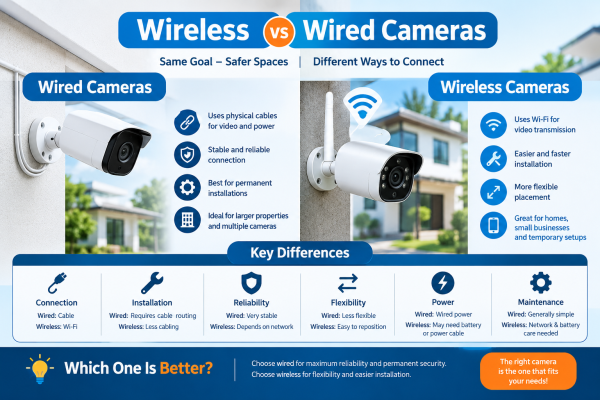
Choosing the right CCTV camera system can be confusing, especially when deciding between wireless and wired cameras. Both options can provide reliable security monitoring, but they differ in installation, connectivity, reliability, maintenance, and overall use.
Understanding these differences can help homeowners, shop owners, offices, and other businesses. It helps them choose a CCTV solution that fits their security needs.
What Are Wired CCTV Cameras?
Wired CCTV cameras use cables to connect to a recording device, like a DVR or NVR. Depending on the camera system, cables may carry video, power, or both.
Traditional wired CCTV systems are widely used in homes, shops, offices, warehouses, schools, and commercial properties. They are popular because they give a stable connection between cameras and the recording system.
Advantages of Wired Cameras
-
Stable connection: Wired cameras are less affected by wireless interference.
-
Reliable video transmission: A properly installed cable can provide consistent video transmission.
-
Suitable for larger properties: Wired systems can be a good choice when multiple cameras are required.
-
Continuous recording: They can support dependable 24/7 surveillance when connected to suitable power and storage.
-
Better for permanent installations: Once installed, the system can provide long-term security monitoring.
Disadvantages of Wired Cameras
-
Installation may require drilling or cable routing.
-
Installation can take longer than a simple wireless setup.
-
Changing the camera location later may require additional cabling.
-
Cable management is important for maintaining a clean installation.
What Are Wireless CCTV Cameras?
Wireless CCTV cameras send video over a wireless network, usually Wi‑Fi. They do not use a dedicated video cable between the camera and recorder. However, many wireless cameras still require a power connection unless they use a battery or another power source.
Wireless cameras can be useful where running cables is difficult or where flexibility is important.
Advantages of Wireless Cameras
-
Flexible placement: Cameras can be easier to relocate when needed.
-
Less cabling: They can reduce the amount of video cabling required.
-
Convenient for certain homes and small businesses: Wireless cameras can be practical where extensive cable installation is undesirable.
-
Easy remote viewing: Many modern wireless cameras support smartphone monitoring through an app.
-
Suitable for temporary or changing setups: They can be useful when camera locations may change.
Disadvantages of Wireless Cameras
-
Wi-Fi signal strength can affect performance.
-
Wireless interference or network congestion may cause connectivity problems.
-
The camera depends on a reliable network connection for wireless transmission.
-
Battery-powered models may require regular charging or battery replacement.
-
Wireless security settings should be properly configured to protect the camera network.
Wireless vs Wired Cameras: Key Differences
|
Feature |
Wired Cameras |
Wireless Cameras |
|
Connection |
Physical cable |
Wireless network |
|
Installation |
Requires cable routing |
Usually requires less video cabling |
|
Reliability |
Generally very stable |
Depends on wireless/network conditions |
|
Flexibility |
Less flexible after installation |
Easier to reposition |
|
Power |
Usually wired power |
May still require power cable or battery |
|
Interference |
Low risk of wireless interference |
Can be affected by Wi-Fi interference |
|
Large properties |
Often suitable |
Depends on network coverage |
|
Maintenance |
Generally straightforward |
Network and battery maintenance may be required |
|
Best suited for |
Permanent security systems |
Flexible and selected residential/small setups |
Which Is Better: Wireless or Wired?
There is no single answer because the better option depends on the property and security requirements.
Wired CCTV cameras are often preferable when reliability, continuous monitoring, and a permanent installation are priorities. They can be particularly suitable for larger homes, offices, shops, warehouses, and commercial properties where dependable connectivity is important.
Wireless cameras can be a convenient choice when flexibility and easier installation are more important. They may work well for apartments, small homes, rental properties, or locations where running cables is difficult.
Factors to Consider Before Choosing
Before purchasing a CCTV camera system, consider the following:
1. Property Size
For a larger property requiring several cameras, a wired system may provide a more dependable infrastructure. Wireless cameras can also work, but adequate network coverage needs to be planned.
2. Wi-Fi Coverage
If you are considering wireless cameras, check the Wi-Fi signal in each camera location.
Make sure the signal is strong and stable.
3. Number of Cameras
A multi-camera system can place greater demands on the network. A wired system may be more appropriate when several cameras need reliable connections.
4. Installation Requirements
If the property is already finished and running cables would be difficult, wireless cameras may offer greater convenience.
5. Recording Requirements
Think about whether you need continuous recording, local storage, cloud storage, or a combination of options. Your recording requirements should influence the type of CCTV system you select.
6. Remote Monitoring
If you want to monitor your home or business from a smartphone, check whether the camera system supports secure remote viewing and whether your internet connection is reliable.
Can Wireless Cameras Be as Reliable as Wired Cameras?
Wireless cameras can offer strong security. They need a stable network connection. They also need enough bandwidth. They need reliable power. They must be set up correctly. However, they have an additional dependency that wired cameras generally do not: the wireless network.
For locations where uninterrupted connectivity is particularly important, a properly installed wired system can offer an advantage.
Can Wired and Wireless Cameras Be Used Together?
Yes. Depending on the equipment and network architecture, some CCTV systems can combine wired and wireless cameras.
For example, a property may use wired cameras in important outdoor or high-traffic areas. It may use wireless cameras in places where it is difficult to run cables.
This hybrid approach can provide a balance between reliability and flexibility.
Final Thoughts
The main difference between wireless and wired CCTV cameras is how they connect to the recording or network infrastructure. Wired cameras use physical cabling and are generally preferred for stable, permanent security systems. Wireless cameras use a wireless network and can provide greater flexibility with less video cabling.
Before choosing a camera, think about your property size. Check your Wi‑Fi coverage. Decide how many cameras you need. Plan how you want to record footage. Consider any installation limits. Think about your long-term security needs.
For homes and businesses in Ghaziabad, Indirapuram, Noida, and Delhi NCR, choose the right CCTV setup for your property.
Do not choose only based on wireless or wired options.
This can help you build a more reliable and effective security system.
Contact us today to find the perfect CCTV solution for your property.