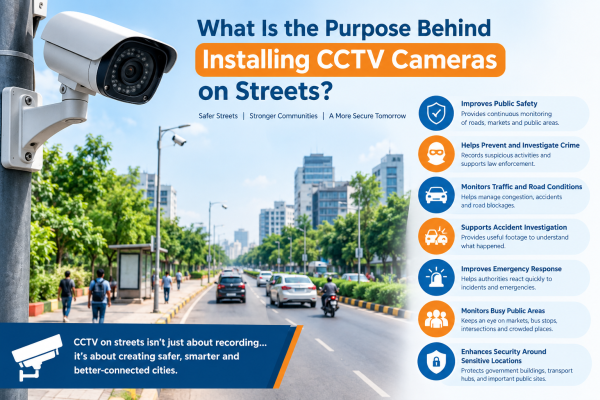
CCTV cameras are becoming increasingly common on roads, public streets, intersections, markets, and other busy areas. Cities and local authorities use street surveillance systems to improve public safety. They monitor traffic and support law enforcement. They also respond to incidents more effectively.
But what is the actual purpose behind installing CCTV cameras on streets? Street CCTV is not only about recording video. A properly planned surveillance system can help authorities monitor public spaces, investigate incidents, manage traffic, and improve overall security.
1. Improving Public Safety
One of the main purposes of installing CCTV cameras on streets is to improve public safety. Cameras can provide constant visual monitoring of key public areas. These include roads, markets, parking areas, intersections, and other busy locations.
The presence of visible cameras may also encourage people to follow traffic and public-safety rules. More importantly, recorded footage can provide useful evidence when an incident occurs.
2. Helping Prevent and Investigate Crime
Street CCTV cameras can support crime prevention and investigation. When cameras are placed in suitable spots, they can record activity in public areas. They may help authorities understand what happened before, during, and after an incident.
For example, CCTV footage may assist in investigating:
-
Theft and property damage
-
Vehicle-related incidents
-
Street fights and public disturbances
-
Vandalism
-
Suspicious activity
-
Hit-and-run incidents
CCTV does not guarantee that crime will be prevented, but recorded footage can be a valuable investigative resource.
3. Monitoring Traffic and Road Conditions
Another important purpose of street CCTV is traffic monitoring. Cameras installed at busy intersections and major roads can help authorities observe traffic conditions in real time.
Traffic monitoring can help identify:
-
Traffic congestion
-
Accidents
-
Road blockages
-
Vehicles stopped in unsafe locations
-
Unusual traffic conditions
-
Crowded intersections
This information can help traffic-management teams respond to problems more quickly.
4. Supporting Accident Investigation
Road accidents can happen within seconds, and eyewitness accounts may not always provide a complete picture. CCTV footage can sometimes help establish the sequence of events.
For example, footage may show the movement of vehicles, pedestrians, or other road users before an accident. Depending on camera position and image quality, this information can assist authorities during an investigation.
High-resolution cameras with suitable night-vision capabilities can also provide useful footage during low-light conditions.
5. Providing Evidence After an Incident
One of the most practical benefits of street surveillance is recorded video evidence.
When an incident occurs, authorized personnel may review footage from the relevant time period. This can help identify people, vehicles, movements, or other details that may not be clear from verbal reports alone.
The usefulness of CCTV footage depends on camera placement, resolution, lighting, storage time, and proper retention of relevant footage.
6. Improving Emergency Response
CCTV cameras can also support emergency response. When cameras are watched in real time, operators may spot accidents, unusual gatherings, road blocks, or other incidents. They can then share useful information with response teams.
In large surveillance networks, many cameras cover more areas.
They show what is happening in different parts of a city or neighbourhood.
This can be particularly useful in busy public areas where conditions can change quickly.
7. Monitoring Busy Public Areas
Markets, bus stops, railway approaches, commercial streets, and crowded intersections can experience high levels of pedestrian and vehicle movement.
Installing CCTV cameras in these locations allows authorized operators to monitor activity and identify situations that may require attention.
The goal is not to watch every person all the time, but to improve visibility in public areas. These areas may have higher security and traffic management concerns.
8. Helping Locate Vehicles and Track Incidents
Street cameras can capture vehicle movements, depending on their position and technical capabilities. In some systems, features such as number-plate recognition may be used where legally permitted and appropriately implemented.
Recorded footage may help authorities investigate vehicle-related incidents such as accidents, theft, or hit-and-run cases.
However, the ability to identify a vehicle depends heavily on factors such as camera resolution, viewing angle, lighting, distance, and image quality.
9. Monitoring During Large Public Events
Large gatherings, festivals, celebrations, sporting events, and other public activities can create significant pedestrian and traffic movement.
CCTV cameras can help authorities monitor crowd movement and identify congestion or other situations requiring attention.
Strategically placed cameras can provide a wider view of entrances, exits, roads, parking areas, and nearby public spaces.
10. Supporting Law Enforcement
Street surveillance can provide law-enforcement agencies with additional information when investigating incidents.
Investigators may not rely only on eyewitness statements. They can review relevant CCTV recordings to establish a timeline. They can also identify important details.
However, CCTV should be one source of information. It should not replace investigation, witnesses, or other evidence.
11. Improving Security Around Sensitive Locations
Certain public locations may require additional security because of their importance or the volume of people using them.
These may include:
-
Government buildings
-
Transport hubs
-
Public parking areas
-
Major road intersections
-
Commercial markets
-
Public institutions
-
Entry and exit points
CCTV can provide an additional layer of monitoring around such locations.
12. Why Camera Placement Matters
Simply installing more cameras does not automatically create a better surveillance system. Camera placement is extremely important.
A street CCTV system should consider:
-
Road direction and traffic flow
-
Camera height
-
Viewing angle
-
Lighting conditions
-
Blind spots
-
Distance from important areas
-
Night-time visibility
-
Weather conditions
-
Required recording duration
A poorly positioned camera may record a large area but provide little useful detail. Proper planning is therefore essential when designing a street surveillance system.
13. The Importance of Night Vision
Street activity continues after dark, making low-light performance an important consideration for outdoor CCTV systems.
Outdoor surveillance cameras may use infrared night vision, low-light imaging, or other tools to record in the dark.
For roads and public areas, choose a camera based on real lighting and distance needs.
This matters more than picking a camera with a high megapixel number.
14. CCTV and Privacy Considerations
Street surveillance can provide security benefits, but public CCTV systems should also be implemented responsibly.
Authorities and organizations operating surveillance systems need to consider applicable laws, privacy requirements, access controls, data retention, and appropriate use of recorded footage.
Cameras should have a clear security or operational purpose. Where required, only authorised personnel should access recordings.
15. Does Street CCTV Completely Stop Crime?
CCTV should not be viewed as a guarantee against crime. Its effectiveness can vary with camera coverage and placement. It also depends on monitoring practices, image quality, and lighting. Maintenance matters too. It also depends on how footage is used after an incident.
The main value of a street CCTV system is that it gives clear visibility and recorded footage.
It also supports security and public safety operations.
Conclusion
The purpose behind installing CCTV cameras on streets is to improve visibility and security in public areas. Street surveillance can help monitor traffic, support emergency response, assist investigations, provide recorded evidence, and improve security around busy or sensitive locations.
However, an effective CCTV system requires more than simply installing cameras. Proper camera selection improves a street surveillance system.
Smart placement improves a street surveillance system.
Enough storage improves a street surveillance system.
Strong networking improves a street surveillance system.
Regular maintenance improves a street surveillance system.
Safe data handling improves a street surveillance system.
For homes, businesses, societies, shops, and other properties, choosing the right CCTV camera for the site matters.
Consider location, lighting, coverage area, and monitoring needs.
This helps make the surveillance system more effective.
Contact us today to find the perfect CCTV solution for your property.