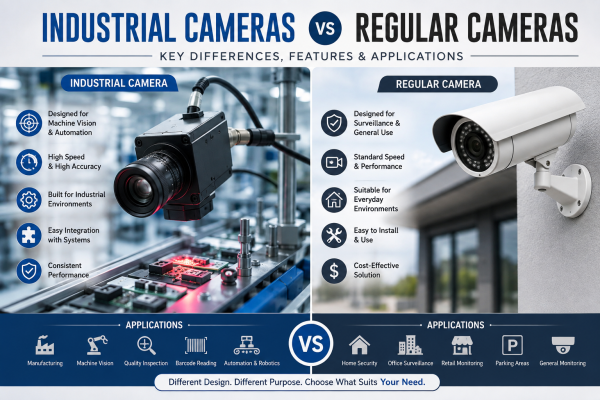
Cameras have become an essential part of modern businesses, manufacturing facilities, security systems, and automation processes. However, not every camera is designed for the same purpose. Industrial cameras and regular cameras may look similar, but they differ significantly in terms of performance, durability, image processing, speed, and applications.
If you wonder about the difference between industrial and regular cameras, this guide can help.
It explains their key features and helps you choose the right camera for your needs.
What Is an Industrial Camera?
An industrial camera is a specialized imaging device designed for demanding applications such as manufacturing, machine vision, automation, quality control, and product inspection.
Unlike standard cameras, industrial cameras are designed to capture images with high accuracy and consistency. They can work with machine vision software, sensors, robots, PLCs, and other automated systems.
Industrial cameras are commonly used for:
-
Quality inspection
-
Defect detection
-
Product measurement
-
Barcode and QR code reading
-
Robotic guidance
-
Assembly verification
-
Production monitoring
-
Automated sorting
-
Machine vision applications
These cameras are particularly useful when businesses need to analyze images automatically rather than simply record or display them.
What Is a Regular Camera?
A regular camera is a general-purpose camera designed for photography, video recording, surveillance, or everyday monitoring. Smartphones, digital cameras, webcams, and many CCTV cameras fall into this category.
Regular cameras are commonly used for:
-
Home security
-
Office surveillance
-
Retail monitoring
-
Photography
-
Video recording
-
Visitor monitoring
-
Property security
-
Remote monitoring
For everyday security and monitoring, a regular CCTV or surveillance camera can provide excellent performance without the specialized features of an industrial camera.
Industrial Cameras vs Regular Cameras: Key Differences
Understanding the major differences between these two camera types is important before choosing a camera for your application.
1. Designed for Different Purposes
The primary difference between an industrial camera and a regular camera is the purpose for which each is designed.
Industrial cameras are developed for machine vision, automation, inspection, and manufacturing. They capture images that can be analyzed by computers and used to make automated decisions.
Regular cameras are mainly designed for photography, video recording, and surveillance.
For example, an industrial camera can inspect hundreds of products each minute on a production line. A CCTV camera can monitor the same area for security.
2. Image Accuracy and Consistency
Industrial applications require highly consistent images. Changes in exposure, lighting, motion, or focus can affect automated inspection results.
Industrial vision cameras provide advanced control over imaging parameters, allowing businesses to capture repeatable images for analysis.
Regular cameras can take high-quality images.
But they may not give the control needed for precise machine vision.
3. Shutter Technology
Shutter technology is another important difference.
Many industrial cameras use global shutters, which capture the entire image at approximately the same time. This helps prevent image distortion when objects are moving quickly.
Regular cameras may use rolling shutter technology. With a rolling shutter, the camera captures each part of the image at different times. This can distort fast-moving objects in photos.
For high-speed manufacturing applications, global shutter technology can be particularly valuable.
4. Speed and Frame Rate
Industrial production lines often operate at high speeds. Industrial cameras can provide high frame rates and precise triggering to capture moving products accurately.
They can also sync with sensors and machines, so the camera takes an image at the right moment.
Regular cameras may record video at high frame rates. But they are not built for precise industrial sync or automated inspection.
5. Continuous Operation
Manufacturing environments may require cameras to operate continuously for long periods.
Industrial cameras are designed for demanding workloads and consistent image acquisition. They can capture many images during production, but they are not mainly for consumer photography or casual recording.
Regular cameras may not be designed for the same type of continuous industrial operation.
6. Integration With Industrial Systems
Industrial cameras are designed to work as part of larger automated systems.
They can be integrated with:
-
Machine vision software
-
PLCs
-
Industrial computers
-
Sensors
-
Robotic arms
-
Conveyor systems
-
Automated inspection systems
For example, a sensor can detect a product on a conveyor belt. It can then trigger an industrial camera to take a picture. Vision software can then analyze the image and determine whether the product meets quality standards.
This level of integration is one of the major advantages of industrial cameras.
7. Durability and Reliability
Industrial environments can expose equipment to dust, vibration, heat, moisture, and continuous operation.
Industrial camera systems can be designed and configured to handle demanding environments and production conditions.
Regular cameras are generally designed for everyday use, although professional CCTV cameras can also offer strong weather resistance and durability.
Industrial Camera vs CCTV Camera
It is important not to confuse industrial cameras with CCTV cameras.
A CCTV camera is primarily designed for security and surveillance. It records activity and allows users to monitor people, buildings, equipment, and property.
An industrial camera is primarily designed for machine vision and automated imaging.
For example:
CCTV camera: Monitors a factory entrance and records people entering and leaving.
Industrial camera: Inspects products moving through a factory production line and identifies defects.
Therefore, the best choice depends on your objective. For security, a CCTV system is generally more appropriate. For automated inspection and manufacturing, an industrial camera is usually the better option.
Applications of Industrial Cameras
Industrial cameras are used across many industries because of their accuracy and automation capabilities.
Manufacturing
Industrial cameras are used for product inspection, defect detection, dimensional measurement, and assembly verification.
Automotive Industry
Automotive manufacturers use machine vision cameras to inspect components, detect defects, and support automated assembly.
Electronics Industry
Industrial cameras can inspect circuit boards and electronic components for missing, damaged, or incorrectly positioned parts.
Food and Beverage
Vision cameras can inspect packaging, labels, product size, shape, color, and placement.
Pharmaceutical Industry
Industrial vision systems can assist with packaging inspection, label verification, counting, and quality control.
Logistics and Warehousing
Industrial cameras can help identify packages, read barcodes, count products, and support automated sorting systems.
Advantages of Industrial Cameras
Using an industrial camera can provide several important benefits:
High precision: Designed for accurate and repeatable image capture.
Fast inspection: Suitable for high-speed production lines.
Automation: Can integrate with robots, sensors, PLCs, and machine vision software.
Consistent performance: Helps maintain reliable inspection results.
Reduced manual inspection: Automated vision systems can reduce the need for repetitive visual checks.
Better quality control: Cameras can identify defects and inconsistencies during production.
Advantages of Regular Cameras
Regular cameras are still the right choice for many applications because they are simple, accessible, and cost-effective.
They are suitable for:
-
Home security
-
Office surveillance
-
Retail stores
-
Schools
-
Warehouses
-
General video recording
-
Property monitoring
For example, homeowners looking for a CCTV camera for home security typically do not need an industrial camera. A modern security camera with HD video, night vision, motion detection, and mobile monitoring may be sufficient.
How to Choose Between an Industrial and Regular Camera?
Before purchasing a camera, consider what you want it to accomplish.
Choose an industrial camera if you need:
-
Machine vision
-
Automated quality inspection
-
High-speed image capture
-
Product measurement
-
Defect detection
-
Robotic guidance
-
Production-line automation
-
Consistent image acquisition
Choose a regular camera or CCTV camera if you need:
-
Home security
-
Office monitoring
-
Retail surveillance
-
General video recording
-
Property monitoring
-
Remote viewing
-
Visitor monitoring
Other factors to consider include resolution, frame rate, shutter type, lens, lighting, connectivity, environmental conditions, storage, software compatibility, and installation requirements.
Conclusion
So, what is the difference between industrial cameras and regular cameras? The biggest difference is their intended purpose and level of performance.
Regular cameras are designed for everyday photography, video recording, and security monitoring. Industrial cameras, on the other hand, are designed for demanding applications involving machine vision, automation, quality inspection, high-speed imaging, and precise image analysis.
Choosing the right camera depends on your specific requirements. If you need security monitoring for your home, office, shop, or property, a reliable CCTV camera can be a practical choice. If you need automated inspection, product measurement, defect detection, or machine vision, an industrial camera may be best.
Understanding the differences between industrial cameras vs regular cameras can help businesses choose the right imaging technology, improve operational efficiency, and achieve better results.