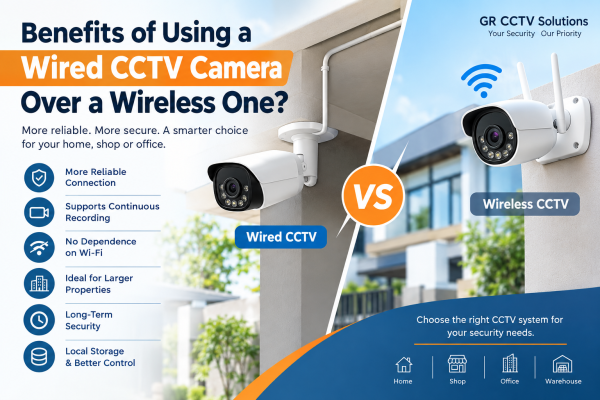
Choosing the right CCTV camera system is essential for protecting your home, shop, office, warehouse, or commercial property. With many security camera options today, people often ask if wired CCTV cameras are better than wireless cameras.
Both systems offer useful security features, but they differ in connectivity, reliability, installation, maintenance, and overall performance. Wired CCTV cameras are often best for properties that need nonstop monitoring and a reliable connection. Wireless cameras are useful where running cables is hard.
In this guide, we will explore the main benefits of wired CCTV cameras over wireless systems. We will also help you choose the best option for your security needs.
1. More Reliable and Stable Connection
One of the biggest advantages of wired CCTV cameras is their stable connection. Wired systems use physical cables to transmit video signals to a DVR or NVR, depending on the camera technology.
Unlike Wi-Fi cameras, wired cameras do not use wireless video. Weak signals, network congestion, and interference can interrupt Wi-Fi cameras.
This makes wired CCTV systems a good choice for shops, offices, warehouses, apartment buildings, and other properties. Reliable monitoring is important in these places.
2. Better Support for Continuous Recording
Security cameras are most useful when they capture important events without unnecessary interruptions. Wired CCTV systems connected to a DVR or NVR can record all the time. This works if the recorder, storage, power, and cameras work properly.
Many wireless cameras support continuous recording. Some models rely on batteries, cloud plans, or motion-triggered recording.
For businesses that review video all day, a wired CCTV system can be a good choice. It records reliably. It also has enough storage for footage.
3. No Dependence on Wi-Fi for Video Transmission
Most Wi-Fi CCTV cameras require a wireless network to transmit footage. If the Wi-Fi signal is weak or the router has problems, remote viewing and other network features may not work.
Traditional wired CCTV cameras use dedicated video cables, while IP cameras can use Ethernet cables for network connectivity. This reduces dependence on Wi-Fi for video transmission.
It is very useful in large homes, multi-story buildings, shops with thick walls, and businesses with uneven Wi-Fi coverage.
Important: Viewing cameras remotely on a mobile phone may still need internet, even if the cameras use cables.
4. A Suitable Choice for Larger Properties
Wired CCTV cameras can be a practical option for properties that require multiple cameras across different locations.
For example, a retail shop may need cameras at the entrance, billing counter, product aisles, stockroom, and rear exit. A warehouse may require monitoring across loading areas, storage sections, and entry gates.
A well-designed wired system connects cameras to a central recorder.
This makes it easier to manage all footage in one place.
Although cable installation needs planning, wired systems provide a clear solution for large installations and long-term security needs.
5. Better Options for Long-Term Security
For homeowners and business owners looking for a permanent security solution, wired CCTV systems can be a worthwhile investment.
Once the cables are installed correctly, the system can run for years with routine maintenance. Components should be replaced when needed. It is not necessary to recharge batteries in conventional wired cameras.
This can be especially helpful for businesses that want security cameras operating throughout working hours and overnight.
However, the actual lifespan and maintenance requirements depend on camera quality, installation standards, environmental conditions, and the condition of the recording equipment.
6. Reduced Risk of Wireless Signal Interference
Wireless cameras use radio signals to communicate. These signals can be affected by distance, obstacles, and interference from other wireless devices.
Wired cameras avoid this particular issue because their primary video signal travels through a cable. This can help maintain consistent video transmission when cables and connectors are installed correctly.
Wired systems are not completely immune to problems. Damaged cables, loose connectors, electrical faults, and network configuration issues can also affect performance.
For locations that need steady video, a professionally installed wired system may be the better choice.
7. No Battery Charging for Conventional Wired Cameras
Battery-powered wireless cameras offer flexibility, but their batteries need recharging or replacement. How frequently this is necessary depends on battery capacity, temperature, recording settings, and how often motion is detected.
Conventional wired CCTV cameras get power from a suitable power supply. In supported IP camera systems, they can also use Power over Ethernet (PoE).
This eliminates routine camera battery charging and can simplify day-to-day operation. The system still needs a reliable power source. A backup power supply may be needed. It can keep cameras recording during power cuts.
8. Better Control Over Recording and Storage
Wired CCTV systems commonly use DVRs or NVRs with local hard-drive storage. This allows users to review recorded footage directly through the recorder, monitor, or supported mobile application.
Local storage can reduce dependence on cloud subscriptions and provide convenient access to footage, depending on the system configuration.
Some wireless cameras also support microSD cards, network video recorders, or local storage hubs. So, local recording is not limited to wired cameras.
Businesses that need to keep footage for days or weeks should choose the right storage size. They should also set recording options and use a system that meets the needed retention time.
9. A Practical Option for Shops and Commercial Properties
Wired CCTV cameras are widely suited to businesses that require several cameras and centralized recording.
They can help monitor:
-
Shop entrances and exits
-
Billing counters and cash-handling areas
-
Offices and reception areas
-
Warehouses and stockrooms
-
Parking spaces and building perimeters
-
Apartment common areas and corridors
For example, a shop owner in Ghaziabad may prefer a wired CCTV system. They can monitor the entrance, billing counter, shelves, and storage area from one DVR.
The best setup depends on the property's layout, lighting conditions, required image quality, and the areas that need coverage.
10. Potentially Lower Ongoing Costs for Certain Setups
The total cost of a CCTV system includes more than the camera price. It may include cables, installation, recording equipment, storage, power supplies, internet services, and maintenance.
Wired CCTV systems may cost more to install at first. This is because cables must run through walls, ceilings, conduits, or other pathways. However, regular wired cameras do not need battery changes. Many systems can also record locally, without a monthly cloud storage subscription.
Wireless systems may be more economical for small installations where cable routing would be expensive. The most cost-effective choice depends on the number of cameras, installation complexity, recording requirements, and long-term maintenance.
Wired CCTV vs Wireless CCTV: Key Differences
|
Feature |
Wired CCTV Camera |
Wireless CCTV Camera |
|
Video connection |
Physical cable |
Usually Wi-Fi or another wireless link |
|
Connection reliability |
Generally stable when installed correctly |
Depends on signal strength and network conditions |
|
Installation |
Cable routing is required |
Often easier where Wi-Fi coverage is available |
|
Battery charging |
Not required for conventional wired cameras |
Required for battery-powered models |
|
Continuous recording |
Commonly supported with a suitable recorder |
Depends on model, power, and recording options |
|
Local storage |
Commonly available through DVR/NVR |
Varies by model |
|
Large installations |
Often suitable for centralized, multi-camera systems |
Can be suitable if wireless coverage and capacity are sufficient |
|
Remote viewing |
Usually requires internet or network access |
Usually requires network access for remote viewing |
|
Best suited for |
Permanent installations and structured coverage |
Flexible installations and locations where cabling is difficult |
Are There Any Disadvantages of Wired CCTV Cameras?
Although wired CCTV cameras offer several benefits, there are a few considerations before choosing them.
1. More installation work: Cables may need to be routed through ceilings, walls, or conduits, increasing installation time.
2. Higher initial installation costs: Labour and cabling can increase the upfront cost, especially in finished buildings.
3. Less flexibility after installation: Moving a camera to another location may require extending or rerouting cables.
4. Dependence on power: Cameras and recording equipment need power. A UPS or other suitable backup can help maintain operation during power cuts.
-
Cable protection: Exposed or poorly installed cables can be damaged or tampered with. Proper routing and protection are important.
Understanding these limitations helps you choose a system that matches your property's layout and security priorities.
When Should You Choose a Wired CCTV Camera?
A wired CCTV system may be the better option if:
-
You want continuous recording for a home or business.
-
You need several cameras connected to one recorder.
-
Your property has unreliable Wi-Fi coverage.
-
You want to avoid charging camera batteries.
-
You need a permanent security installation.
-
You want to keep recorded footage on a local DVR or NVR.
Wireless cameras work well when you need fast setup, move cameras often, or cannot run cables easily. Some properties benefit from a combination of wired and wireless cameras.
How to Choose the Right Wired CCTV System
Before purchasing a wired CCTV camera system, consider these factors:
-
Camera resolution: Pick a resolution that matches how much detail you need.
-
Use a higher resolution if you need to recognize faces.
-
Use a higher resolution if you need to read signs at an entrance.
Night vision: Check whether infrared or colour night vision is suitable for the lighting conditions around your property.
Camera type: Dome cameras can suit many indoor spaces, while weather-rated bullet cameras are often used outdoors. The best choice depends on placement and coverage requirements.
DVR or NVR: Analog HD cameras often connect to DVRs. IP cameras usually use NVRs or compatible network recording systems.
Storage capacity: Choose a hard drive based on your camera count, resolution, frame rate, recording schedule, and retention time.
Mobile viewing: If you want to monitor your property from anywhere, make sure the system supports mobile access. Set it up with strong security settings.
Professional installation: Correct camera positioning, protected cable routing, suitable power supplies, and proper recorder configuration can make a significant difference to system performance.
Conclusion
Wired CCTV cameras have several benefits over wireless cameras. They provide a stable video connection. They support centralized recording. Most models do not need regular battery charging. They also work well for permanent multi-camera setups.
They are often a good choice for homes, shops, offices, warehouses, and other businesses that need reliable monitoring. Wireless cameras, however, can be more convenient for smaller installations or locations where running cables is difficult.
The right choice depends on your budget, property layout, recording requirements, and installation preferences. Compare these factors before investing in a CCTV system so that your security setup meets your needs both now and in the long term.
If you want to install CCTV cameras at your home, shop, or office, GR CCTV Solutions can help.
We serve Ghaziabad, Indirapuram, Noida, and Delhi NCR. They can help you choose the right cameras and system setup for your property.
Contact us today to find the perfect CCTV solution for your property.