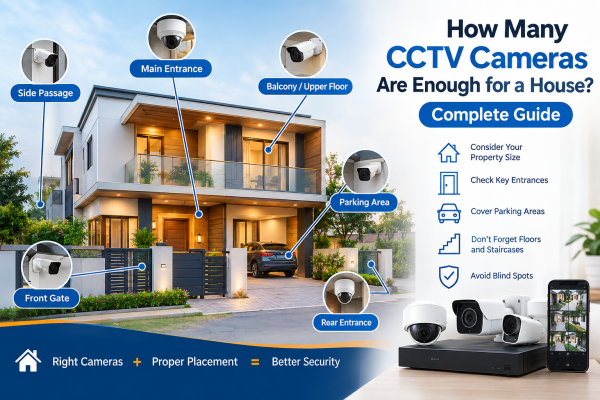
Choosing the right number of CCTV cameras for your home is key to an effective security system. Installing too few cameras can leave key areas unprotected.
Installing too many can raise costs without adding much security.
So, how many cameras are enough for a house CCTV system?
For most homes, 4 to 8 CCTV cameras provide good coverage. The ideal number depends on property size, entrances, floors, parking areas, and security needs. However, there is no fixed number that works for every house.
This guide explains how to decide the right number of CCTV cameras for your home.
How Many CCTV Cameras Does a House Usually Need?
The number of cameras depends mainly on the size and layout of your property.
A general guideline is:
-
Small apartment or 1 BHK: 2–4 cameras
-
2 BHK house: 4–6 cameras
-
3 BHK house: 4–8 cameras
-
Large independent house: 6–10 or more cameras
-
House with large parking, garden, or multiple entrances: 8–12+ cameras may be required
These numbers are only starting points. Camera placement and viewing angles are more important than simply installing a large number of cameras.
Important Areas That Should Have CCTV Coverage
Instead of deciding the number of cameras based only on the number of rooms, identify the areas where security monitoring is most important.
1. Main Entrance
The main entrance is one of the most important locations for a CCTV camera. A camera here can monitor people entering and leaving the property.
For better identification, choose a camera with suitable resolution, good night vision, and an appropriate viewing angle.
2. Front Gate
If your house has a boundary gate or driveway, installing a camera near the gate can provide an additional layer of security.
A camera positioned toward the gate can help monitor visitors, vehicles, deliveries, and activity outside the property.
3. Parking Area
If your vehicle is parked outside or in an open parking area, consider installing a dedicated camera.
The camera should cover the parking space without creating unnecessary blind spots.
4. Back Door or Rear Entrance
The rear side of a property can sometimes be overlooked when planning CCTV coverage.
A camera facing the back door, staircase, or rear passage can help monitor another important access point.
5. Side Passage
For houses with narrow passages along the sides, a camera can be useful for monitoring movement around the property.
Whether a separate camera is necessary depends on the viewing angle of cameras already installed nearby.
6. Staircase
For multi-floor houses, staircases can be important monitoring points.
A strategically positioned camera can cover movement between floors without requiring a separate camera on every floor.
7. Living Room or Common Area
Indoor cameras may be useful for monitoring important common areas, especially when homeowners want additional security while away.
However, cameras should be installed with privacy in mind. Bedrooms and private areas generally should not be monitored with CCTV.
Example: CCTV Camera Setup for a Typical 3 BHK House
A typical 3 BHK independent house might need around 6 cameras, depending on the layout.
A possible arrangement could be:
-
Main entrance – 1 camera
-
Front gate – 1 camera
-
Parking area – 1 camera
-
Rear entrance – 1 camera
-
Side passage – 1 camera
-
Staircase/common area – 1 camera
This setup can provide coverage of the property's major entry points and movement areas.
However, if two cameras can effectively cover the same area, installing an additional camera may not be necessary.
Does Every Room Need a CCTV Camera?
No. Every room does not need a CCTV camera.
The purpose of a home CCTV system is to monitor important security zones rather than place a camera in every room.
For many homes, outdoor entry points and common areas provide more useful security coverage than installing cameras throughout bedrooms and private spaces.
A well-planned system with fewer strategically positioned cameras can be more effective than a large number of poorly positioned cameras.
What Determines the Number of CCTV Cameras?
Several factors should be considered before choosing the number of cameras.
Property Size
A larger property generally requires more cameras because there are more areas to monitor.
Number of Entrances
A home with a main gate, side gate, front door, rear door, and garage may require cameras at multiple access points.
Number of Floors
A two- or three-storey house may need additional cameras for staircases, corridors, balconies, and entrances.
Camera Viewing Angle
The lens and viewing angle of a camera determine how much area it can cover.
A wide-angle camera may cover a larger area, while a narrow-angle camera can provide more focused monitoring.
Lighting Conditions
If an area becomes very dark at night, choose a camera with suitable night vision rather than assuming that any camera will provide clear footage.
Blind Spots
The main goal should be to reduce important blind spots. A camera count should be decided after checking what existing cameras can and cannot see.
Should You Choose 4, 6, 8, or More Cameras?
There is no universal answer.
4 cameras may be sufficient for a small house with a simple layout.
6 cameras can be a practical choice for many medium-sized independent homes, especially when there are several entrances and outdoor areas.
8 cameras may be suitable for larger houses, multi-floor properties, or homes with additional parking, garden, balcony, or side passages.
Homes with larger plots, multiple gates, servant entrances, garages, or extensive outdoor areas may require more cameras.
The important point is to choose cameras based on coverage requirements rather than simply choosing a higher camera count.
Wired or Wireless CCTV Cameras?
The number of cameras can also influence whether you choose a wired or wireless CCTV system.
Wired CCTV systems can be suitable for permanent installations where reliable connections and centralized recording are important.
Wireless cameras can be useful in situations where running cables is difficult or where flexible placement is required.
However, wireless does not automatically mean better. Your home's Wi-Fi coverage, power availability, network stability, and camera location should all be considered.
Do You Need 24/7 Recording?
If your goal is continuous security monitoring, a CCTV system with an NVR or DVR and sufficient storage can record footage throughout the day.
Alternatively, some modern cameras support motion-based recording, which can reduce storage requirements by recording primarily when activity is detected.
The right recording method depends on the security requirements of your property.
How to Avoid CCTV Blind Spots
Simply installing more cameras does not guarantee complete coverage.
Before installation, check:
-
Main entrance visibility
-
Gate and driveway coverage
-
Parking area
-
Rear entrance
-
Side passages
-
Staircases
-
Garden or outdoor areas
-
Important corridors
-
Areas hidden behind walls or structures
Cameras should be positioned so that important areas overlap where necessary without unnecessarily duplicating the same view.
Can One Camera Cover Multiple Areas?
Sometimes, yes.
For example, a properly positioned wide-angle camera near an entrance may cover both the doorway and part of the surrounding passage.
However, a camera should not be stretched beyond its practical viewing range. A very wide field of view can make distant objects appear smaller, which may reduce identification quality.
Therefore, the goal should be useful coverage and clear footage, not simply maximum coverage.
Consider Image Quality, Not Just Camera Quantity
A house with eight low-quality cameras may provide less useful footage than a house with four properly selected cameras.
When choosing a CCTV system, consider:
-
Camera resolution
-
Night vision performance
-
Lens type
-
Viewing angle
-
WDR performance
-
Motion detection
-
Storage capacity
-
Remote mobile viewing
-
Weather protection for outdoor cameras
-
Recording requirements
A professional assessment can help determine which combination is appropriate for your property.
How Much Storage Do You Need?
The number of cameras also affects storage requirements.
For example, eight cameras recording continuously will generally require more storage than four cameras using motion-based recording.
Storage requirements depend on factors such as:
-
Number of cameras
-
Resolution
-
Recording hours
-
Frame rate
-
Compression technology
-
Continuous or motion recording
-
Required retention period
Before purchasing an NVR or DVR, calculate the storage requirement based on your preferred recording schedule.
Final Thoughts
So, how many cameras are enough for a house CCTV system?
For many homes, 4 to 8 strategically positioned cameras can provide effective security coverage. Smaller properties may need fewer cameras, while larger homes with multiple entrances, floors, parking areas, and outdoor spaces may require more.
The best CCTV system is not necessarily the one with the most cameras. It is the system that provides clear coverage of important areas while minimizing blind spots and respecting privacy.
Before selecting the final number of cameras, evaluate your home's entrances, property boundaries, parking, staircases, outdoor areas, lighting conditions, and recording requirements.
A properly planned CCTV system can provide reliable monitoring and help you keep a closer eye on your home, whether you are inside the property or checking it remotely from your mobile phone.
Contact us today to find the perfect CCTV solution for your property.