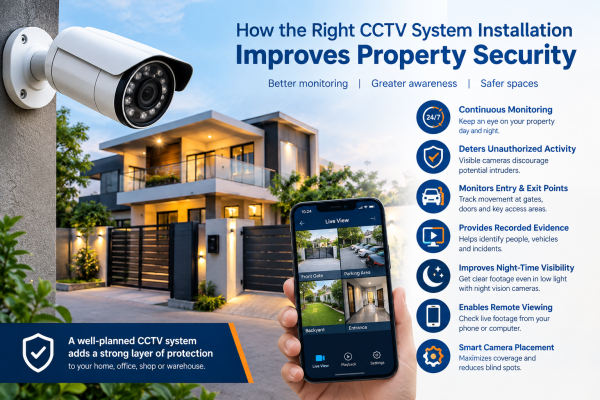
Property security has become an important consideration for homeowners, businesses, offices, shops, warehouses, and residential communities. A well-planned CCTV system can provide constant video monitoring and help owners know what happens around their property.
However, simply installing cameras is not enough. The effectiveness of a CCTV system depends on choosing suitable cameras, positioning them correctly, using reliable recording equipment, and maintaining the system properly.
What Is a CCTV System?
A CCTV (Closed-Circuit Television) system is a video system.
It uses cameras to record activity.
It records activity in a chosen area. Depending on the system, footage can be recorded on a DVR, NVR, memory card, or other storage solution.
Modern CCTV systems may also have night vision, motion detection, mobile viewing, two-way audio, and AI detection.
How Can the Right CCTV Installation Improve Property Security?
1. Provides Continuous Monitoring
A CCTV system can monitor important areas of a property throughout the day and night. Cameras can be installed around entrances, gates, corridors, parking areas, reception areas, shops, and other locations that require monitoring.
This allows property owners or security personnel to maintain better awareness of activity around the premises.
2. Helps Deter Some Unauthorized Activity
Visible security cameras can make people aware that their activities may be recorded. This may discourage some opportunistic unauthorized activity.
However, CCTV should not be considered a guarantee that crime or unauthorized access will never occur. It works best as one part of a broader security strategy.
3. Helps Monitor Entry and Exit Points
Doors, gates, entrances, and other access points are important areas for CCTV coverage. Properly positioned cameras can record people and vehicles entering or leaving a property.
For businesses, this can also help security staff understand movement around customer and employee entrances.
4. Provides Recorded Evidence
One of the major advantages of CCTV is the ability to record events for later review.
If an incident occurs, recorded footage may help show what happened. It can also provide details about people, vehicles, movements, or the order of events. The usefulness of footage depends on factors such as camera placement, image quality, lighting, and storage duration.
5. Improves Night-Time Visibility
Security concerns do not stop after sunset. Outdoor areas such as parking spaces, entrances, gates, and pathways may require monitoring at night.
Cameras with infrared or other night-vision capabilities can help capture footage in low-light or dark conditions. Selecting the appropriate night-vision camera for the environment is important for maintaining useful image quality after dark.
6. Enables Remote Monitoring
Many modern CCTV systems can be connected to a network and accessed through smartphones or computers.
Remote viewing can allow property owners to check live footage while they are away. Depending on the system, users may also receive motion or other event notifications.
This can be very useful for homeowners, shop owners, and business managers who cannot always be at the property.
7. Helps Monitor Larger Areas
A well-designed CCTV system can cover multiple areas using different camera types.
For example, wide-angle cameras work well in open areas. Focused cameras monitor entrances or other specific points of interest. Larger properties may require multiple cameras to reduce blind spots.
The goal should be meaningful coverage rather than simply installing the maximum possible number of cameras.
8. Supports Employee and Workplace Security
Businesses can use CCTV to monitor common areas, entrances, exits, storage areas, and other appropriate locations.
Besides security, recorded footage may help investigate incidents such as unauthorized access, property damage, or disputes. Businesses should ensure that CCTV usage complies with applicable privacy and workplace requirements.
9. Helps Protect Valuable Areas
Certain parts of a property may require greater attention than others. These could include cash counters, inventory storage areas, server rooms, equipment rooms, parking areas, or restricted entrances.
Installing cameras specifically where security risks are higher can make the surveillance system more practical and cost-effective.
Choosing the Right CCTV Camera
Different properties have different surveillance requirements. Some of the factors to consider include:
-
Camera resolution: Higher resolution can provide more image detail.
-
Viewing angle: Choose a field of view appropriate for the area.
-
Night vision: Important for locations requiring nighttime monitoring.
-
Weather resistance: Outdoor cameras should be designed for outdoor conditions.
-
Motion detection: Can help identify movement and reduce unnecessary recordings.
-
AI-based detection: Some systems can distinguish people or vehicles from general movement.
-
Storage capacity: Consider how many days of recordings you need.
-
Remote viewing: Useful when monitoring the property from another location.
-
Audio: Depending on the camera and local requirements, audio features may be useful in certain applications.
Why Camera Placement Matters
Even a high-quality camera may provide limited security if it is installed in the wrong location.
Cameras should be positioned to provide useful views of important areas while minimizing unnecessary blind spots. Factors such as lighting, height, viewing angle, obstacles, and potential tampering should be considered during planning.
For example, placing a camera directly toward a strong light source may affect image quality. Similarly, an outdoor camera positioned behind an obstruction may fail to provide the expected coverage.
CCTV Storage and Recording
A surveillance system is only useful if important footage is properly recorded and retained.
DVR- and NVR-based systems commonly use hard drives designed for surveillance recording. Storage requirements depend on:
-
Number of cameras
-
Camera resolution
-
Frame rate
-
Continuous or motion-based recording
-
Compression technology
-
Desired retention period
Before you install a CCTV system, estimate the storage you need. Do not choose a hard drive based only on capacity.
Regular CCTV Maintenance Is Important
Installing a CCTV system is the beginning of a security solution, not the end.
Cameras can become dirty, cables can develop faults, storage devices can experience problems, and network connections may fail. Regular maintenance can help identify these issues before they affect surveillance.
An Annual Maintenance Contract (AMC), where appropriate, can provide scheduled inspections and technical support for maintaining CCTV equipment.
CCTV Is One Part of Property Security
A CCTV system should not be treated as a replacement for every other security measure. Physical locks, access control, alarms, adequate lighting, security personnel, and proper security procedures can all play important roles.
The purpose of CCTV is to complement these measures by providing visual monitoring and recorded information.
Conclusion
The right CCTV system installation can improve property security. It provides nonstop monitoring and helps deter unauthorized activity. It records key events, improves night visibility, and allows remote access to live footage.
However, the effectiveness of CCTV depends on proper planning. Camera selection, placement, lighting, recording equipment, storage, networking, and regular maintenance should all be considered before installation.
Whether it is a home, office, retail shop, warehouse, or other property, a CCTV system should fit that site’s needs. It should not follow a one-size-fits-all approach.
Contact us today to find the perfect CCTV solution for your property.