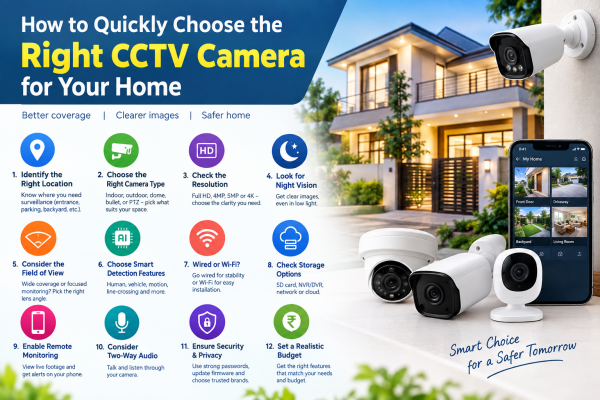
Choosing a CCTV camera for your home can be confusing because there are so many options available. From Wi-Fi cameras and dome cameras to 4K cameras and AI-powered security systems, there are many options. Each model has its own features. Each model has its own specs.
The good news is that you don't need to be a CCTV expert to make the right choice. By focusing on a few important factors—location, coverage, resolution, night vision, storage, connectivity, and smart features—you can quickly narrow down your options.
1. Decide Where You Need CCTV Cameras
The first step is to identify the areas that require surveillance.
Common locations include:
-
Main entrance and front door
-
Garage and driveway
-
Parking area
-
Backyard and garden
-
Stairways and corridors
-
Living room and common areas
-
Building entrances and gates
-
Other vulnerable areas around the property
Make a simple list of these locations before buying cameras. This will help you determine the number and type of cameras required.
2. Choose Indoor or Outdoor CCTV Cameras
Not every CCTV camera is suitable for outdoor installation.
For outdoor areas, choose cameras designed to withstand environmental conditions such as dust, rain, and temperature changes. Check the manufacturer's IP rating and installation specifications.
For indoor areas, compact dome cameras or Wi-Fi cameras can be suitable depending on your requirements.
Tip: Don't install an indoor-only camera outdoors just because it offers good video quality.
3. Select the Right CCTV Resolution
Resolution determines the amount of detail captured by the camera.
Common CCTV resolutions include:
-
2MP / Full HD: Suitable for basic home monitoring.
-
4MP: Provides more image detail and can be useful for entrances and larger rooms.
-
5MP: Offers additional detail for many residential applications.
-
8MP / 4K: Useful when higher image detail is important.
However, higher resolution isn't automatically better for every situation. The lens, lighting, sensor, compression, and camera placement also have a major impact on image quality.
4. Check Night Vision Performance
Security is needed during the night as well as during the day.
When choosing a CCTV camera, check its low-light and night-vision capabilities. Many cameras use infrared light to show black-and-white images in the dark. Some models use advanced sensors and lights to show color images in low light.
For areas such as entrances, gates, driveways, and parking spaces, nighttime performance should be one of your key considerations.
5. Consider the Field of View
The field of view determines how much area the camera can see.
A wide-angle camera can cover a larger area, making it useful for rooms, gardens, and open spaces. However, if you need to monitor a specific entrance or gate from far away, the right lens matters more than the widest angle.
Before installation, consider:
-
Distance from the camera to the target
-
Width of the area
-
Potential blind spots
-
Camera mounting height
-
Lighting conditions
Proper placement can make a significant difference to the usefulness of a CCTV system.
6. Look for AI-Based Detection
Modern CCTV cameras can offer AI-powered features that go beyond basic motion detection.
Depending on the camera model, these may include:
-
Human detection
-
Vehicle detection
-
Intrusion detection
-
Line-crossing detection
-
Area monitoring
-
Smart notifications
-
Intelligent video search
For example, human detection can help differentiate people from certain types of irrelevant movement, potentially reducing unnecessary alerts.
If you often get alerts from normal movement, like animals or trees, smart detection features can help.
7. Choose Between Wired and Wi-Fi CCTV
Your home's layout and networking requirements should influence your choice between wired and wireless cameras.
Wired CCTV Cameras
Wired cameras often connect to an NVR or DVR. They offer a stable connection for multi-camera setups.
They can be particularly suitable for:
-
Large homes
-
Multiple-camera systems
-
Continuous recording
-
Long-term installations
Wi-Fi CCTV Cameras
Wi-Fi cameras can be convenient where installing network cables is difficult.
They may offer features such as:
-
Smartphone monitoring
-
Motion notifications
-
Two-way audio
-
Local or cloud storage
-
Easy installation
However, a Wi-Fi camera still needs reliable power and a strong wireless connection at the install location.
8. Decide How Much Recording Storage You Need
Storage is another important consideration.
Depending on the system, CCTV footage can be stored on:
-
MicroSD cards
-
NVR/DVR hard drives
-
Network storage
-
Cloud services
The storage you need depends on your camera count, resolution, recording schedule, frame rate, compression, and retention time.
If you want continuous recording for several weeks, you will need much more storage. This is more than if the cameras record only when an event occurs.
9. Consider Remote Mobile Monitoring
Many modern CCTV systems allow homeowners to view their cameras remotely through a smartphone application.
Depending on the system, you may be able to:
-
Watch live footage
-
View recorded video
-
Receive security notifications
-
Use two-way audio
-
Control PTZ cameras
-
Check multiple cameras remotely
This can be useful if you regularly travel or want to check your property while you're away.
10. Think About Two-Way Audio
Two-way audio can turn a CCTV camera into a communication device as well as a surveillance tool.
A camera has a microphone and a speaker.
It lets you talk with visitors, delivery staff, or family.
You can do this through a compatible mobile app.
Before using audio recording, make sure your use complies with applicable privacy and recording laws.
11. Check the Camera's Security Features
Because many modern CCTV cameras connect to the internet, cybersecurity is important.
When setting up your system:
-
Use a strong, unique password.
-
Keep camera firmware updated.
-
Use secure network connections.
-
Update the associated mobile application.
-
Avoid exposing camera services unnecessarily to the public internet.
-
Purchase equipment from reliable sources.
Physical security is important, but the digital security of an internet-connected CCTV system should not be overlooked.
12. Set a Realistic Budget
CCTV prices can vary considerably depending on features and specifications.
Instead of buying the cheapest or the most expensive camera, focus on what your property needs. Choose the features that matter most.
For example, a basic indoor camera may not need 4K resolution or advanced AI tools. An outdoor entrance camera may need better night vision, higher resolution, and person or vehicle detection.
The goal should be to match the camera's capabilities with your actual security requirements.
Quick CCTV Camera Selection Checklist
If you want to choose a CCTV camera quickly, answer these questions:
|
Requirement |
What to Consider |
|
Location |
Indoor or outdoor |
|
Coverage |
Small, medium, or large area |
|
Resolution |
Full HD, 4MP, 5MP, or 4K |
|
Night monitoring |
IR or color night vision |
|
Connectivity |
Wired or Wi-Fi |
|
Recording |
NVR/DVR, SD card, or cloud |
|
Detection |
Motion, human, or vehicle detection |
|
Audio |
Microphone and two-way communication |
|
Remote access |
Smartphone monitoring |
|
Weather protection |
Appropriate outdoor rating |
|
Budget |
Features required vs. total cost |
Final Thoughts
Finding the right CCTV camera for your home is easier when you focus on your security needs. Don’t just look for the highest resolution or the most features.
Start by identifying where you need surveillance. Then consider the camera type, resolution, field of view, night vision, storage, connectivity, AI detection, and remote monitoring options.
For a small apartment, a few strategically placed Wi-Fi cameras may be sufficient. For a larger house or property, a professionally planned multi-camera NVR system may provide more comprehensive coverage.
Most importantly, camera placement matters just as much as camera specifications. A well-placed camera with good lighting and coverage can be more useful than a high-end camera in the wrong spot.
By following these steps, you can compare CCTV cameras quickly. You can then choose a home security system that fits your property, monitoring needs, and budget.
Contact us today to find the perfect CCTV solution for your property.