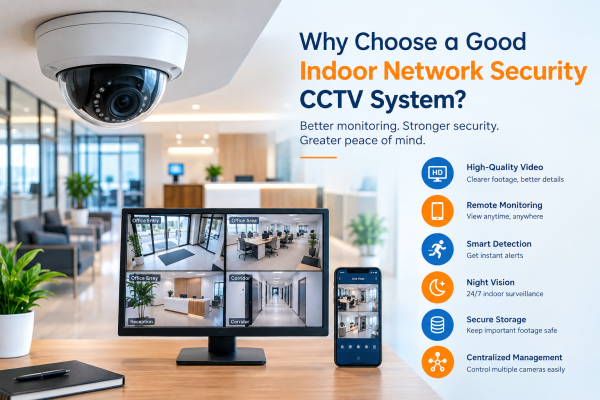
Security has become an important consideration for homes, offices, retail stores, schools, warehouses, clinics, and other indoor spaces. A good indoor network security CCTV system can monitor all the time. It can help prevent incidents. It can also make it easier to respond when something unusual happens.
Unlike basic cameras that only record video, a well-designed network CCTV system offers high-quality footage.
It also provides remote access, smart alerts, and centralized management. But why should you invest in a good indoor network security CCTV system? Let's look at the main reasons.
1. Continuous Indoor Monitoring
One of the biggest benefits of an indoor CCTV system is that it can monitor key areas day and night.
Cameras can be installed in locations such as:
-
Office entrances and reception areas
-
Retail shops and cash counters
-
Hallways and corridors
-
Warehouses and storage areas
-
Apartment common areas
-
Schools and classrooms
-
Clinics and waiting areas
Continuous recording can help provide a clear picture of what is happening inside the premises.
2. Better Security and Crime Deterrence
Visible CCTV cameras can discourage unauthorized activities and certain types of theft or misconduct. When people know that an area is being monitored, they may be less likely to engage in unwanted behavior.
CCTV is not a guarantee against crime, but it can be an important part of a broader security strategy.
3. High-Quality Video Evidence
A good network CCTV system can provide clearer footage than older or low-quality surveillance cameras.
Depending on the camera model, useful features may include:
-
HD or higher-resolution video
-
Wide-angle coverage
-
Good low-light performance
-
Infrared night vision
-
Digital WDR
-
Noise reduction
-
Motion detection
Clear footage can be particularly useful when reviewing an incident and identifying people, objects, or activities.
4. Remote Viewing From Your Smartphone
Modern network CCTV cameras can often be connected to a network, allowing authorized users to view cameras remotely.
For example, a shop owner can check the premises while away. An office manager can review activity without being there.
Remote viewing can make an indoor CCTV system more convenient and practical for everyday security monitoring.
5. Real-Time Alerts and Smart Detection
Many modern IP CCTV cameras include intelligent features that go beyond traditional video recording.
Depending on the model and system configuration, features may include:
-
Motion detection
-
Human detection
-
Vehicle detection
-
Intrusion detection
-
Line-crossing alerts
-
Tampering alerts
These features can reduce the need to watch every camera all the time. They can draw attention to important events.
6. Centralized Network Management
One major benefit of an indoor CCTV network system is that you can connect several cameras to a network. You can then manage them all in one place.
Instead of using separate standalone cameras, users can manage multiple cameras with an NVR or a suitable surveillance platform.
This is particularly useful for offices, stores, schools, warehouses, and other premises with multiple monitoring points.
7. Better Coverage of Important Areas
Choosing the right camera is just as important as choosing a good brand or recording system.
Different indoor areas may require different camera specifications. For example, a wide-angle camera may work well in a room. A camera with a narrower view may be better for a specific entrance or counter.
Proper placement can help reduce blind spots and improve overall coverage.
8. Night-Time Indoor Surveillance
Security concerns do not disappear after business hours.
A good indoor CCTV camera with strong low-light performance or infrared night vision can keep recording in poor lighting.
This can be especially useful for shops, offices, warehouses, and other premises that remain unattended overnight.
9. Reliable Recording and Storage
A CCTV system is only useful if important footage is recorded and can be retrieved when required.
Network CCTV systems commonly use an NVR and surveillance-grade storage to record video from multiple cameras.
Before selecting a system, consider:
-
Number of cameras
-
Required recording duration
-
Camera resolution
-
Continuous or event-based recording
-
Storage capacity
-
Backup requirements
These factors determine how much storage the system will need.
10. Scalability for Future Expansion
A good network CCTV system can be easier to expand when security requirements increase.
For example, a business may initially install cameras at the entrance, reception, and cash counter. Later, additional cameras may be required in a warehouse or another section of the premises.
Planning the network and recording system with future expansion in mind can prevent unnecessary replacement costs.
11. Improved Monitoring for Businesses
For businesses, CCTV can provide benefits beyond security.
It can help monitor:
-
Customer areas
-
Employee activity
-
Cash counters
-
Stock rooms
-
Entry and exit points
-
Restricted areas
When used responsibly and in accordance with applicable privacy requirements, CCTV can support both security and operational monitoring.
12. Helps Investigate Security Incidents
Even when CCTV does not prevent an incident, recorded footage can help reconstruct what happened.
For example, footage may help determine:
-
When an incident occurred
-
Who entered an area
-
What happened before an incident
-
Which direction someone moved
-
Whether an entry point was accessed
This makes CCTV valuable not only for prevention but also for post-incident investigation.
13. Network Security Should Also Be Considered
Because IP CCTV cameras connect to a network, cybersecurity is important when choosing an indoor network CCTV system.
Users should consider cameras and recording equipment from reliable manufacturers and follow good security practices such as:
-
Using strong, unique passwords
-
Updating firmware when appropriate
-
Limiting unnecessary remote access
-
Securing the network
-
Creating appropriate user permissions
-
Changing default credentials
A CCTV system should protect the premises without unnecessarily creating another security risk.
What Should You Consider Before Choosing an Indoor Network CCTV System?
Before purchasing a system, don't focus only on megapixels or price. Consider the complete security requirement.
Important factors include:
Camera Resolution
Choose a resolution appropriate for the distance and level of detail you need.
Field of View
Check whether the camera can cover the required area without leaving significant blind spots.
Night Vision
For areas that become dark, check the camera's low-light and infrared performance.
Storage
Calculate how many days of footage you need and select suitable storage capacity.
Network Infrastructure
IP cameras require appropriate networking, cabling, switches, and power arrangements depending on the system design.
Remote Access
If you need mobile monitoring, check whether the camera/NVR supports secure remote viewing.
Smart Features
Human detection, motion detection, and other AI-based features can be useful where intelligent monitoring is required.
Reliability and After-Sales Support
A CCTV system is a long-term security investment. Product reliability, warranty, technical support, and availability of replacement components should also be considered.
Indoor Network CCTV vs Basic CCTV: What's the Difference?
A basic CCTV setup may focus mainly on recording video. A modern network CCTV system offers more features. It provides network access and centralized recording. It also supports remote monitoring and smart detection. It makes it easier to manage multiple cameras.
The right option depends on the size of the premises, security requirements, budget, network infrastructure, and desired features.
Conclusion
Choosing a good indoor network security CCTV system can provide much more than simple video recording. It can offer continuous monitoring, clearer footage, remote viewing, intelligent alerts, centralized management, and useful evidence when a security incident occurs.
For homes and businesses, the best system is not necessarily the most expensive one. The goal is to choose cameras, recording equipment, storage, networking, and security features that meet the site’s needs.
A well-planned indoor network CCTV system can be a key part of your security plan. It helps you monitor key areas. It also helps you respond faster to security concerns.
Contact us today to find the perfect CCTV solution for your property.