CCTV cameras are an important part of security systems. They are used in homes, offices, shops, factories, schools, warehouses, and government facilities. However, when you buy a CCTV camera in India, you may see terms like STQC camera.
You may also see STQC-certified CCTV camera and non-STQC camera.
Many buyers assume that STQC cameras simply provide better picture quality than non-STQC cameras. That is not necessarily true. The major difference is related to security requirements, testing, certification, and regulatory or procurement compliance.
In this guide, we explain the difference between STQC and non-STQC CCTV cameras.
We explain what STQC certification means.
We also cover who may need it.
We share what you should check before buying a CCTV system.
What Is STQC?
STQC stands for Standardisation Testing and Quality Certification Directorate. It operates under India's Ministry of Electronics and Information Technology (MeitY) and provides testing and certification services for electronic and IT products.
For CCTV cameras, STQC testing under the applicable framework evaluates products against specified Essential Requirements (ERs) for security. The purpose is to improve confidence in the cybersecurity and supply-chain security of CCTV products.
These requirements can cover hardware, firmware, interfaces, software components, supply-chain security, and protection from some security threats.
What Is an STQC CCTV Camera?
An STQC CCTV camera is a camera model or product setup. It has passed STQC evaluation against Essential Security Requirements.
The certification applies to the specific product and evaluated configuration, rather than automatically applying to every camera made by the same manufacturer. For example, an STQC certificate can identify particular model numbers and configurations covered by the certificate.
Therefore, simply purchasing a camera from a manufacturer that has some STQC-certified products does not automatically mean that every model from that manufacturer is STQC certified.
What Is a Non-STQC CCTV Camera?
A non-STQC CCTV camera is a camera without the required STQC certification.
It also lacks security test documents for the specific requirement.
This does not automatically mean that the camera is poor quality or unsafe. A non-STQC camera can still give excellent video quality.
It can support night vision.
It may offer storage and motion detection.
You can also view footage remotely.
It can include other useful features too.
The important difference is that the buyer should not assume that the camera has been evaluated under the relevant STQC/MeitY security certification framework unless there is appropriate documentation.
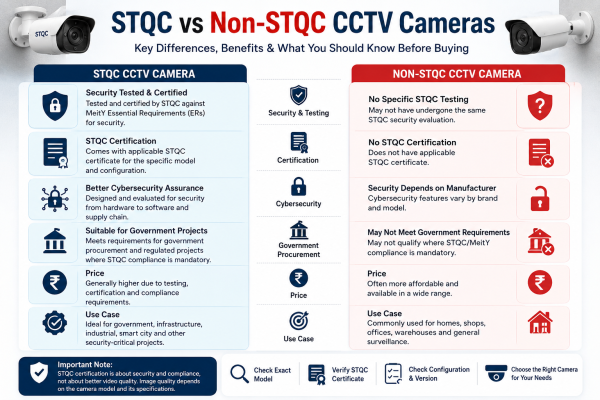
STQC vs Non-STQC CCTV Cameras: Key Differences
|
Feature |
STQC CCTV Camera |
Non-STQC CCTV Camera |
|
Security evaluation |
Evaluated against applicable security requirements |
No applicable STQC evaluation for the specified requirement |
|
Certification |
Applicable STQC certification/test documentation available |
Applicable STQC certification may not be available |
|
Cybersecurity assurance |
Provides additional assurance against specified requirements |
Depends on manufacturer and individual product |
|
Government procurement |
May be required for applicable government procurement |
May not satisfy procurement requirements where compliance is mandatory |
|
Image quality |
Depends on the camera model |
Depends on the camera model |
|
Night vision |
Depends on specifications |
Depends on specifications |
|
Price |
May be comparatively higher |
Often available at different price points |
|
Home/retail use |
Can be used where appropriate |
Commonly used where STQC compliance is not required |
|
Model verification |
Specific model/configuration should be checked |
No STQC model certification to verify |
Is STQC Certification About Picture Quality?
No.
This is one of the most important points to understand.
STQC certification is primarily related to specified security and compliance requirements; it does not automatically mean better resolution or better video quality.
For example, a non-STQC camera could have a higher megapixel rating than an STQC-certified camera. Similarly, a camera's night vision performance depends on its sensor, lens, infrared illumination, image processing, and other specifications.
Therefore, when comparing CCTV cameras, you should consider both security compliance and technical performance.
What Security Areas Are Considered?
The MeitY Essential Requirements include security requirements. These requirements cover trusted sources. They also cover supply-chain security. They include critical hardware, firmware, and interfaces. They also protect against counterfeit or compromised components.
STQC guidance specifically discusses security-critical components such as the SoC, firmware, PCBA, network interface card, and physical interfaces.
This is very important for network-connected CCTV cameras. These cameras can collect and send sensitive video and other data.
Why Is CCTV Cybersecurity Important?
Modern IP CCTV cameras are essentially network-connected computing devices. They may connect to:
-
Local networks
-
NVRs
-
Routers
-
Cloud platforms
-
Mobile applications
-
Remote monitoring systems
If such devices are poorly secured, unauthorized users could potentially attempt to access the camera or its data.
This is one reason MeitY's security requirements focus not only on the physical camera.
They also cover firmware, hardware components, interfaces, and supply-chain security.
Are STQC Cameras Mandatory for Everyone?
No. The requirement depends on the applicable regulatory and procurement framework.
MeitY has notified CCTV cameras under the Public Procurement (Preference to Make in India) Order (PPP-MII).
It has also brought CCTV cameras under the Compulsory Registration Order (CRO) framework.
This is to meet specified security requirements.
According to a MeitY clarification from February 2026, the relevant orders took effect on 7 June 2024.
This applies to PPP-MII.
For CRO, the relevant orders took effect on 9 April 2025. The clarification also says that security testing reports for CCTV/VSS, under the applicable framework, are issued by STQC.
They may also be issued by another agency notified by MeitY.
Therefore, buyers should determine whether their particular purchase, project, tender, or regulatory situation requires the applicable compliance.
STQC Certification and Government CCTV Projects
STQC compliance can be particularly important for government procurement and projects where the tender or applicable regulations specify the relevant security requirements.
For such projects, simply selecting a camera based on price or megapixel count may not be sufficient. The buyer should verify:
-
Exact camera model number
-
Applicable certificate or security test report
-
Manufacturer/OEM details
-
Evaluated hardware and software configuration
-
Certificate validity
-
Whether the certificate covers the intended requirement
STQC currently maintains information about CCTV testing and certification under its IoT System Certification Scheme.
Can a Non-STQC Camera Be Good Quality?
Yes.
Being non-STQC does not automatically mean a camera is bad.
A CCTV camera should be evaluated according to the application. For a home, shop, office, or small business, image quality, night vision, and storage may matter.
Mobile access, warranty, and reliability may also be important.
Good installation and after-sales support can help too.
For a government or regulated project, however, applicable certification and security compliance may become essential.
Therefore, STQC status and camera quality should be treated as two different considerations.
What Should You Check Before Buying an STQC Camera?
If a seller tells you that a particular CCTV camera is STQC certified, do not rely only on the statement.
Ask for the relevant documentation and verify that:
-
The exact model is covered.
-
The manufacturer/OEM matches the certificate.
-
The evaluated configuration is relevant to the product being supplied.
-
The certificate is applicable to the required security framework.
-
The certificate has not expired.
-
Any firmware or hardware version requirements are satisfied.
This is very important. In 2026, STQC clarified that older certificates under its IoT System Certification Scheme may not be valid.
They are not valid for the PPO/PPP-MII camera requirement by default.
Products must be validated against the Essential Requirements in the relevant MeitY notification.
STQC Does Not Mean "Government Approved Camera"
Another common misunderstanding is that STQC certification means the government recommends or endorses a particular camera.
That is not necessarily the case.
An STQC certificate confirms evaluation/certification against the applicable requirements and conditions. For example, STQC certificates can clearly state that this certification is not a Government of India product endorsement.
So, it is more accurate to describe an STQC camera as one that has passed the required security evaluation.
This is better than calling it a “government-approved camera.”
Which Is Better: STQC or Non-STQC?
There is no single answer for every buyer.
Choose an STQC-compliant camera when:
-
The project specifically requires STQC/MeitY compliance.
-
You are working on an applicable government procurement project.
-
Your tender specifies the relevant security certification.
-
Cybersecurity and supply-chain assurance are important project requirements.
-
You need documented compliance for a particular procurement framework.
A non-STQC camera may be suitable when:
-
STQC compliance is not required for your project.
-
You are installing CCTV for a home or small business.
-
Your main requirements are surveillance, recording, night vision, and remote monitoring.
-
You have evaluated the manufacturer's security practices and product reliability.
-
The camera meets your technical and budget requirements.
STQC vs Non-STQC: Don't Compare Only the Price
The cheapest CCTV camera is not always the best choice.
When comparing two products, consider:
Video quality:
Look at resolution, sensor quality, lens, dynamic range, and image processing.
Night vision:
Check infrared range and low-light performance rather than relying only on marketing claims.
Storage:
Consider NVR, DVR, SD card, or other supported storage options.
Cybersecurity:
For network cameras, consider firmware updates, passwords, authentication, secure communication, and manufacturer support.
Certification:
If required, verify the applicable STQC/MeitY documentation.
Warranty and service:
A reliable after-sales service network can be important for long-term CCTV operation.
Installation:
Even a high-quality camera can perform poorly if it is incorrectly positioned or configured.
Final Thoughts
The main difference between STQC and non-STQC CCTV cameras is not simply camera resolution or image quality. The key distinction is whether the particular camera has undergone the applicable STQC/MeitY security evaluation and certification requirements.
STQC certification can provide additional documented assurance for applicable security requirements and can be particularly important for government and regulated procurement. However, non-STQC does not automatically mean that a camera is poor quality.
Before purchasing, always identify the purpose of the CCTV system and check the exact requirements of your project. For government or regulated projects, verify the relevant certificate and model. For residential and commercial installations, compare security, image quality, night vision, storage, reliability, warranty, and overall value.
Choosing the right CCTV camera is ultimately about finding the right balance between security compliance, technical performance, reliability, and budget.
Contact us today to find the perfect CCTV solution for your property.