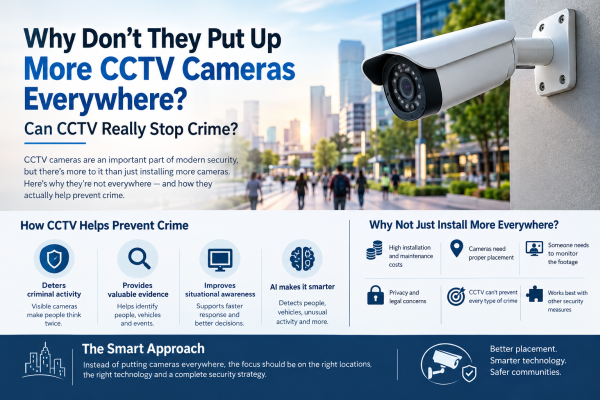
CCTV cameras have become an important part of modern security. They can be seen outside homes, shops, offices, factories, parking areas, roads, residential societies, and public places. This often leads to a simple question. Why don’t authorities and businesses install CCTV cameras everywhere? CCTV cameras can help prevent crime
The answer is more complicated than simply installing more cameras.
CCTV can be an effective security tool. It works best with proper camera placement and active monitoring. It also needs good lighting, trained security staff, and a suitable response system. Research shows that CCTV can reduce crime a little. The effect is stronger in some places, like parking areas and some homes.
How Can CCTV Help Prevent Crime?
One of the biggest advantages of CCTV is its potential deterrent effect.
When people know an area is monitored, they may think twice before theft, vandalism, trespassing, or other offences. Visible cameras can make a place seem harder to target. This is because they may record proof of the activity.
However, CCTV does not guarantee that crime will never happen. A determined offender may still commit a crime, especially if cameras are poorly placed. Nobody may be monitoring the footage.
CCTV Can Also Help Investigate Crimes
CCTV is not only about preventing crime. Recorded footage can also become valuable evidence after an incident.
For example, CCTV footage may help investigators identify:
-
The approximate time an incident occurred
-
People or vehicles present at the location
-
The direction in which someone travelled
-
Vehicle details such as colour or registration information when clearly captured
-
How an incident took place
-
Possible witnesses or related activity
Research has also found that public surveillance cameras can sometimes improve case-clearance outcomes. However, the benefit depends on factors like camera proximity and the type of offence.
So Why Not Install CCTV Cameras Everywhere?
There are several practical reasons.
1. Cost of Installation and Maintenance
Installing thousands or millions of cameras requires significant investment.
The cost is not limited to purchasing cameras. A complete surveillance system may require:
-
Cameras
-
Cabling or network infrastructure
-
PoE switches
-
DVRs or NVRs
-
Hard drives or other storage
-
Power systems
-
Monitoring equipment
-
Internet connectivity
-
Security personnel
-
Regular maintenance and replacement
Public authorities and private organizations therefore have to decide where cameras will provide the greatest security benefit.
2. Cameras Need Proper Placement
More cameras do not automatically mean better security.
A poorly positioned camera can produce footage that is difficult to use. For example, a camera mounted too high may capture a wide area but fail to provide useful facial or identification details.
Camera placement should cover entrances and exits. Place cameras in parking areas and blind spots. Include valuable assets and access points. Focus on locations with higher security risks.
Research shows CCTV works best with wide coverage and active monitoring, not just recording footage that nobody watches.
3. Someone Needs to Monitor the Cameras
A CCTV camera can record an event, but recording alone may not stop a crime as it happens.
Active monitoring can allow security personnel or authorities to notice suspicious activity and respond more quickly.
Modern systems can improve this process through features such as:
-
Human detection
-
Vehicle detection
-
Intrusion detection
-
Line-crossing alerts
-
Loitering detection
-
Motion detection
-
People counting
-
Automatic notifications
AI-powered CCTV can help reduce the amount of irrelevant footage that security teams need to review.
4. Privacy Is Another Important Consideration
Putting cameras everywhere also creates privacy concerns.
Public surveillance needs to balance security benefits with people's reasonable expectations of privacy and applicable laws and regulations. Organizations should consider camera locations, what areas they record, and how long they keep footage. They should also consider who can access recordings and how they protect the footage.
A responsible CCTV system should therefore have appropriate access controls, secure storage, defined retention policies, and clear operational procedures.
5. CCTV Cannot Prevent Every Type of Crime
It is important not to assume that CCTV automatically prevents all criminal activity.
Research has found that the effectiveness of CCTV varies depending on the location and type of crime. Systematic reviews found strong evidence of vehicle-related crime in parking areas. Violent crime results were less consistent.
This means CCTV should be considered one component of a broader security strategy rather than a standalone solution.
CCTV Works Better With Other Security Measures
A strong security system usually combines several measures.
For example, a commercial property might use:
CCTV + security guards + access control + good lighting + alarms + perimeter protection
Street lighting can improve visibility. Access control can block unauthorized entry. Alarms can give immediate warnings. Trained security staff can respond to incidents.
Research has found that CCTV systems can be more effective when combined with complementary security measures.
What About AI CCTV Cameras?
Modern CCTV technology is becoming considerably more intelligent.
Traditional cameras primarily record video. AI-enabled cameras can analyze video and identify specific events or objects.
For example, an AI CCTV system may be configured to generate an alert when:
-
A person enters a restricted area
-
A vehicle enters a prohibited zone
-
Someone crosses a virtual line
-
A person remains in an area for an unusual period
-
A specific security rule is violated
This can make surveillance more proactive because security personnel do not necessarily need to watch every camera continuously.
However, AI detection is not perfect. Performance can depend on camera quality, lighting, viewing angle, environmental conditions, configuration, and the particular analytics technology being used.
Should Cities and Businesses Install More CCTV Cameras?
In many situations, yes—but strategically rather than randomly.
Instead of putting cameras everywhere, authorities and businesses should identify areas with higher security risks and deploy suitable cameras there.
Useful locations may include:
-
Parking areas
-
Building entrances and exits
-
ATMs and financial areas
-
Retail stores
-
Warehouses
-
Industrial premises
-
Residential society entrances
-
Public transport areas
-
Perimeters and gates
-
High-value storage areas
-
Roads and intersections where appropriate
The goal should be effective surveillance rather than simply increasing the number of cameras.
What Makes a CCTV System Effective?
A useful CCTV system depends on several factors:
Camera Selection
Choose the camera according to the location, lighting, required viewing distance, and security objective.
Correct Installation
Camera height, viewing angle, lighting, and coverage should be planned carefully.
Adequate Storage
The system should have enough storage for the required recording period.
Reliable Networking
IP cameras require a stable and secure network infrastructure.
Active Monitoring
Important locations may benefit from live monitoring and trained security personnel.
Regular Maintenance
Cameras, storage devices, cables, power supplies, and network equipment should be checked regularly.
Cybersecurity
Network-connected cameras should use strong passwords, controlled access, updated firmware where appropriate, and secure network configurations.
Final Thoughts
So, why don't they simply install CCTV cameras everywhere?
Because CCTV is only one part of crime prevention. Cameras can discourage some crimes, provide useful evidence, improve awareness, and support investigations. But they cannot replace police work or security staff. They also cannot replace good lighting, access control, community safety measures, or effective emergency response.
The evidence suggests CCTV can reduce crime slightly, especially when it is used in the right areas. It works best when someone monitors it and it is paired with other security measures.
The better question is therefore not “Why don't we install CCTV everywhere?”
It is:
“Where can CCTV provide the greatest security benefit, and how can it be integrated with other security measures?”
A well-designed CCTV system in the right locations can be more valuable than many poorly placed cameras. These cameras may only record footage without effective monitoring or response.
Contact us today to find the perfect CCTV solution for your property.